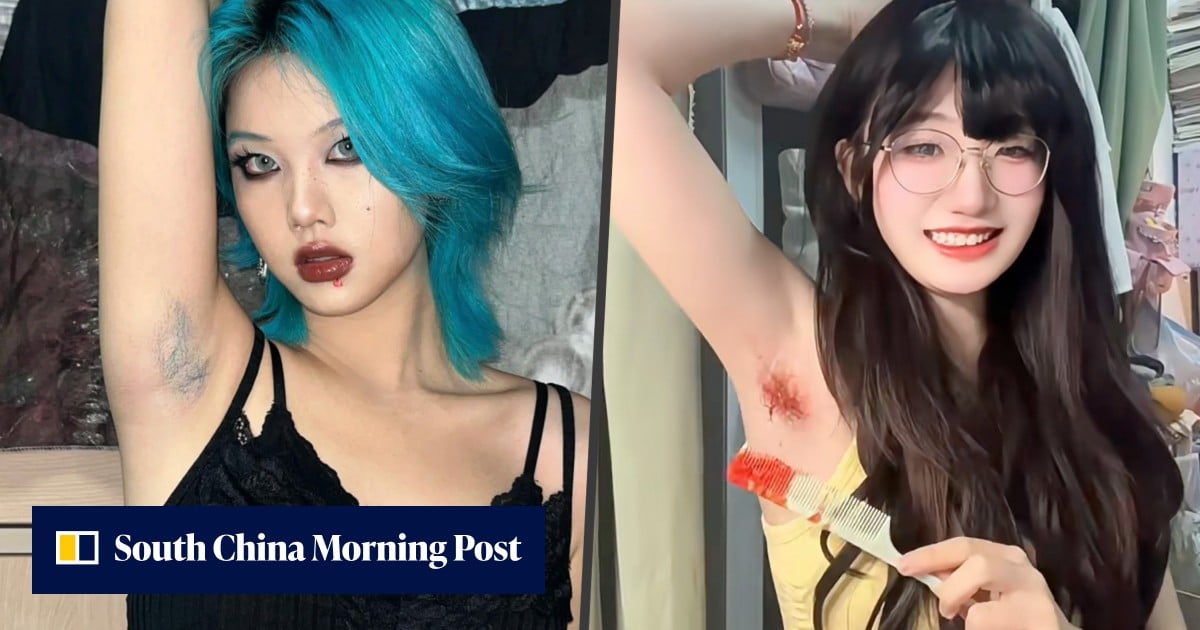
Young Chinese women dye armpit hair as fashion statement and expression of bodily autonomy
Some young women in China are dyeing their armpit hair, transforming a once-stigmatised trait into both a fashion statement and an assertion of bodily autonomy. The trend is not without precedent. Lady Gaga made headlines with green underarm hair in 2011, while brightly dyed armpit hair and “glitter pits” – underarms embellished with glitter – have since surfaced on social media worldwide. In recent years, Chinese social media has played a pivotal role in popularising the trend among younger...
Places named in this report: China
Exact coordinates
china: 35.860, 104.200
Read it at South China Morning Post See this on the map
What might happen next? AI-generated
These scenarios are written by an AI language model from the headline and summary above. They are not predictions from the newsroom, and they are not evidence of anything. Every one is given a deadline and checked against later coverage, and the score is published on the ledger — including the ones that miss.
-
Unresolved 45% Rapid Social Acceptance/Normalization
The trend gains significant mainstream traction beyond niche social media groups, leading to endorsements from minor public figures or fashion influencers. This suggests a rapid cultural shift where bodily autonomy in personal grooming is widely accepted by the younger generation and slowly filtering into broader societal norms.
Watch for: A major Chinese fashion magazine publishes a feature profiling 'Body Art' trends in personal grooming. · A high-profile celebrity or public intellectual publicly discusses the trend in a televised interview without censure.
-
Unresolved 30% Targeted Localized Crackdown
Local municipal authorities in a major city identify the trend as a violation of local public decency ordinances, leading to swift, localized enforcement actions. The response will be administrative rather than broad national legislation, targeting specific venues or public spaces.
Watch for: A local district government releases a public notice or fines are issued specifically related to personal adornments in public spaces. · A municipal police department issues a new guidance document referencing 'modesty' in local enforcement.
-
Unresolved 15% State-Sanctioned Cultural Diversion
Rather than suppressing the trend, state-affiliated media rebrands it. The government incorporates the concept of 'self-expression' into a broader, controlled narrative about youth creativity, thereby co-opting the autonomy discussion for ideological ends.
Watch for: A state-run media outlet runs a campaign titled 'Modern Youth Aesthetic' that features the trend positively. · A Ministry of Culture official releases a policy document acknowledging 'individual creative expression' within defined parameters.
-
Unresolved 10% Counter-Trend Institutional Backlash (Counter-intuitive)
In a sharp reversal, established traditional or conservative social commentary circles launch a highly publicized, organized backlash against the trend, framing it not as autonomy, but as a dangerous descent into chaos or Western cultural imitation.
Watch for: A prominent conservative academic or established news commentator publishes a highly critical opinion piece regarding 'cultural erosion'. · A religious or traditional community organization issues a public statement condemning the trend.
Generated by gemma-4-E4B-it-qat-UD-Q4_K_XL.gguf
on 2026-08-22. Checked against later coverage after 2026-08-29.
See how these forecasts score.
ForecastGeo shows the headline and summary published by the newsroom and places the story on a map. The full article lives at the source.