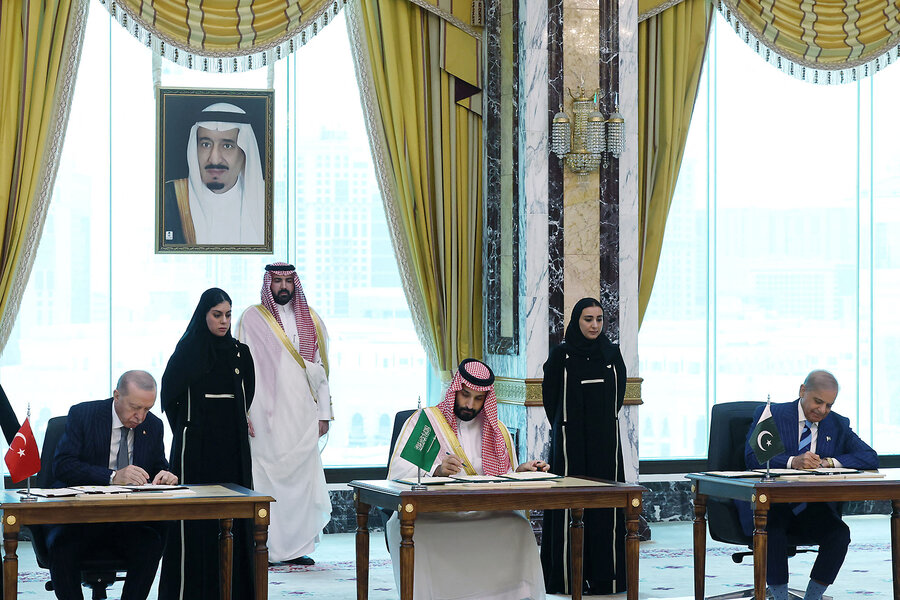
With Middle East still at war, three regional powers ink a new alliance
The Saudi-Turkish-Pakistani compact is a response to the prolonged Iran war, an Israel perceived as seeking hegemony, and the failure of other diplomatic initiatives. It also anticipates a reduced U.S. regional posture. Does that help the United States?
Where: India, Saudi Arabia, Pakistan, Israel, Iran, Iraq, China, United States, Washington, Turkey, London
Exact coordinates
india: 20.590, 78.960
saudi arabia: 23.890, 45.080
pakistan: 30.380, 69.350
israel: 31.050, 34.850
iran: 32.430, 53.690
iraq: 33.220, 43.680
china: 35.860, 104.200
united states: 37.090, -95.710
washington: 38.910, -77.040
turkey: 38.960, 35.240
london: 51.510, -0.130
Read it at The Christian Science Monitor See this on the map
6 outlets covered this story — see how their framing differs
What might happen next? AI-generated
These scenarios are written by an AI language model from the headline and summary above. They are not predictions from the newsroom, and they are not evidence of anything. Every one is given a deadline and checked against later coverage, and the score is published on the ledger — including the ones that miss.
-
Unresolved 40% Immediate Deterrence Alignment
The new alliance immediately begins coordinated intelligence sharing and joint military exercises, signaling a unified front against perceived external threats. This move aims to stabilize regional influence before the US posture shifts significantly. Regional powers test the boundaries of the compact's commitment.
Watch for: Saudi and Turkish military commanders hold a joint operational briefing within 7 days. · An official joint statement details shared intelligence protocols.
-
Unresolved 30% US Reassurance and De-escalation
The formation of the alliance is interpreted by Washington as a manageable, if unwelcome, realignment, prompting a targeted diplomatic outreach. The US offers specific security guarantees to the Saudi bloc to prevent the compact from hardening further.
Watch for: A high-ranking US State Department official issues a formal briefing praising 'regional stability efforts.' · The US announces increased direct security consultations with Riyadh within 10 days.
-
Unresolved 20% Internal Fracture Over Scope
Despite the initial signing, disagreements over operational boundaries and shared risk emerge quickly, particularly regarding Iran. Pakistan pushes for a more purely economic angle, causing friction with the more militarily inclined Saudi faction.
Watch for: A joint press release from the three nations includes an explicit caveat regarding 'internal policy divergences.' · Pakistani diplomatic envoys express concerns over the scope of the military commitments during a secondary meeting.
-
Unresolved 10% Unilateral Regional Escalation (Counter-Trajectory)
The alliance serves as a catalyst for immediate, unilateral military action against perceived regional adversaries, bypassing the need for broader consensus. This aggressive posture shocks global markets and forces immediate, sharp reactions from non-aligned powers.
Watch for: A coordinated, non-attributable drone strike is announced by a member state against a target previously deemed off-limits. · The alliance issues a joint declaration of 'red lines' against a specific neighboring state within 72 hours.
Generated by gemma-4-E4B-it-qat-UD-Q4_K_XL.gguf
on 2026-08-11. Checked against later coverage after 2026-08-18.
See how these forecasts score.
ForecastGeo shows the headline and summary published by the newsroom and places the story on a map. The full article lives at the source.