Why was China’s response to North Korea’s latest missile launches so muted?
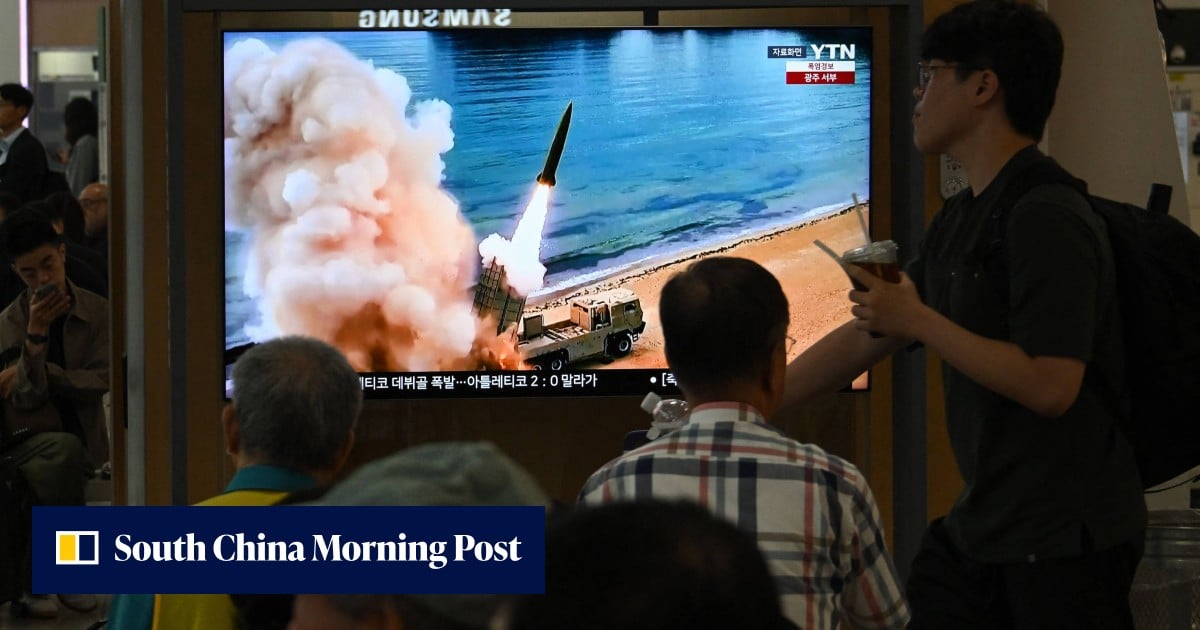
China’s muted response to North Korea’s latest missile launch, which came soon after top diplomat Wang Yi’s visit to Seoul, underscores how Beijing is prioritising Pyongyang’s stability over near‑term denuclearisation, according to analysts. North Korea started launching more than 10 short-range ballistic missiles just hours after Wang concluded his two-day visit on Thursday, the foreign minister’s first official trip to South Korea in nearly five years. South Korea and Japan condemned the...
Places named in this report: Seoul, Beijing
Exact coordinates
seoul: 37.570, 126.980
beijing: 39.900, 116.400
Read it at South China Morning Post See this on the map
What might happen next? AI-generated
These scenarios are written by an AI language model from the headline and summary above. They are not predictions from the newsroom, and they are not evidence of anything. Every one is given a deadline and checked against later coverage, and the score is published on the ledger — including the ones that miss.
-
Unresolved 40% Tension De-escalation via Regional Dialogue
China leverages its relationship with North Korea to pressure Pyongyang, while South Korea uses the lull to push for a direct, high-level tripartite security meeting involving Beijing. Wang Yi signals a more active diplomatic role post-Seoul, shifting the focus from mere observation to active mediation. This prevents immediate military escalation.
Watch for: China announces a scheduled 'high-level working group' meeting involving North Korean delegates within 7 days. · South Korean Defense Minister holds a televised press conference detailing a proposed 'three-party security consultation' framework.
-
Unresolved 35% Sustained Status Quo with Increased Pressure
Beijing continues its policy of 'stability maintenance' but subtly signals that the current level of provocation is unsustainable. North Korea continues its testing, but China issues a formal, written 'note of concern' to Pyongyang, setting an implicit red line for future launches.
Watch for: A formal diplomatic cable or statement from the Chinese Ministry of Foreign Affairs is released condemning specific, advanced missile tests. · North Korean state media reports a 'strategic pause' in missile tests following the release of the Chinese note.
-
Unresolved 15% Sudden Regional Crisis and Military Posturing
A North Korean missile test, perhaps an intercept-defying variant, triggers an immediate and disproportionate reaction from South Korea or Japan. Beijing is forced to react defensively to prevent a direct conflict spilling into its sphere, leading to increased troop movements near the border.
Watch for: South Korea issues an immediate emergency directive to deploy additional KAMD (Korean Air and Missile Defense) assets to the DMZ. · China announces a temporary 'border security reinforcement' operation near the Yalu River.
-
Unresolved 10% Counter-Intuitive Diplomatic Breakthrough
Despite the military actions, the strategic value of the China-North Korea bond reaches a tipping point. Beijing decides that complete isolation is not worth the risk, and initiates a highly visible, secret channel to Pyongyang to discuss specific, tangible economic incentives tied to a temporary moratorium.
Watch for: A high-ranking, unnamed Chinese official is quoted by an international agency as meeting a North Korean counterpart outside of formal diplomatic channels. · A major international commodity exchange sees a sudden spike in regional trade stocks following a cryptic statement from Beijing.
Generated by gemma-4-E4B-it-qat-UD-Q4_K_XL.gguf
on 2026-08-25. Checked against later coverage after 2026-09-04.
See how these forecasts score.
ForecastGeo shows the headline and summary published by the newsroom and places the story on a map. The full article lives at the source.