Why submarine attacks may prove to be the Achilles’ heel for China’s new carrier fleet
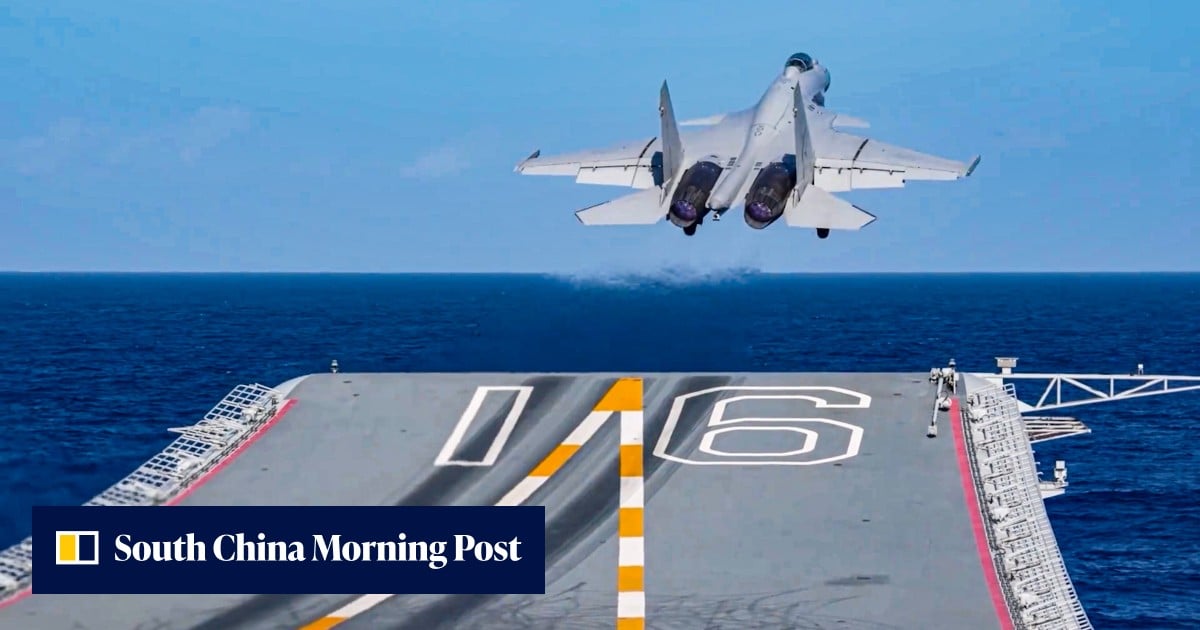
China’s rapidly expanding aircraft carrier fleet may be vulnerable to attack from submarines – an area where its defensive capacity lags behind that of the United States – according to a new report. This gap is drawing increasing attention as Beijing builds more sophisticated carriers and sends them deeper into the western Pacific, where the People’s Liberation Army Navy (PLAN)’s knowledge of the undersea environment continues to lag behind that of the US Navy. A recent report from the...
Where: China, United States, Washington, Beijing
Exact coordinates
china: 35.860, 104.200
united states: 37.090, -95.710
washington: 38.910, -77.040
beijing: 39.900, 116.400
Read it at South China Morning Post See this on the map
2 outlets covered this story — see how their framing differs
What might happen next? AI-generated
These scenarios are written by an AI language model from the headline and summary above. They are not predictions from the newsroom, and they are not evidence of anything. Every one is given a deadline and checked against later coverage, and the score is published on the ledger — including the ones that miss.
-
Unresolved 40% US Naval Posturing Escalation
In response to the report highlighting Chinese vulnerability, the US Navy conducts a high-visibility, aggressive anti-submarine warfare (ASW) exercise near contested waters. This is framed publicly as a 'freedom of navigation' drill but specifically targets Chinese carrier transit routes. Beijing reacts by increasing its own submarine deployments in the area.
Watch for: US Navy announces 'Operation Trident Shield' targeting the western Pacific. · A public joint statement from the PLAN and US Navy condemning 'unnecessary provocation' in the South China Sea.
-
Unresolved 30% Chinese Military Doctrine Shift
Recognizing the strategic intelligence gap exposed by the report, the PLA prioritizes rapid indigenous ASW development. China announces a major new procurement or testing phase for its own next-generation undersea detection systems. This move aims to quickly close the perceived vulnerability gap before external pressure mounts.
Watch for: The Chinese Ministry of Defense releases a detailed blueprint or announcement regarding a 'Project Trident' ASW upgrade. · A domestic military procurement contract for advanced sonar systems is publicly awarded.
-
Unresolved 20% Subtle Diplomatic De-escalation
Amid rising regional tensions, a neutral third-party power (e.g., Japan or Australia) pressures both sides to de-escalate maritime tensions through a technical working group. This group focuses on standardized safety protocols for naval operations, effectively creating a temporary 'rules of engagement' framework.
Watch for: A ministerial-level meeting between Chinese and US defense attachés is announced in a third country. · A joint declaration establishing a 48-hour 'non-aggressive zone' for submarine transit is issued.
-
Unresolved 10% Technological 'Black Box' Failure (Counter-Intuitive)
Instead of immediate tactical shifts, a critical, unannounced failure occurs in a key piece of US surveillance hardware or data-sharing capability relevant to the report. This brief intelligence failure causes a temporary lull in high-level military exchanges as both sides recalibrate their situational awareness assumptions.
Watch for: US defense contractors issue a mandatory public recall or software patch announcement for a specific maritime sensor suite. · A prominent Western defense analyst tweets about a sudden 'data void' in Western undersea surveillance capabilities.
Generated by gemma-4-E4B-it-qat-UD-Q4_K_XL.gguf
on 2026-08-11. Checked against later coverage after 2026-08-21.
See how these forecasts score.
ForecastGeo shows the headline and summary published by the newsroom and places the story on a map. The full article lives at the source.