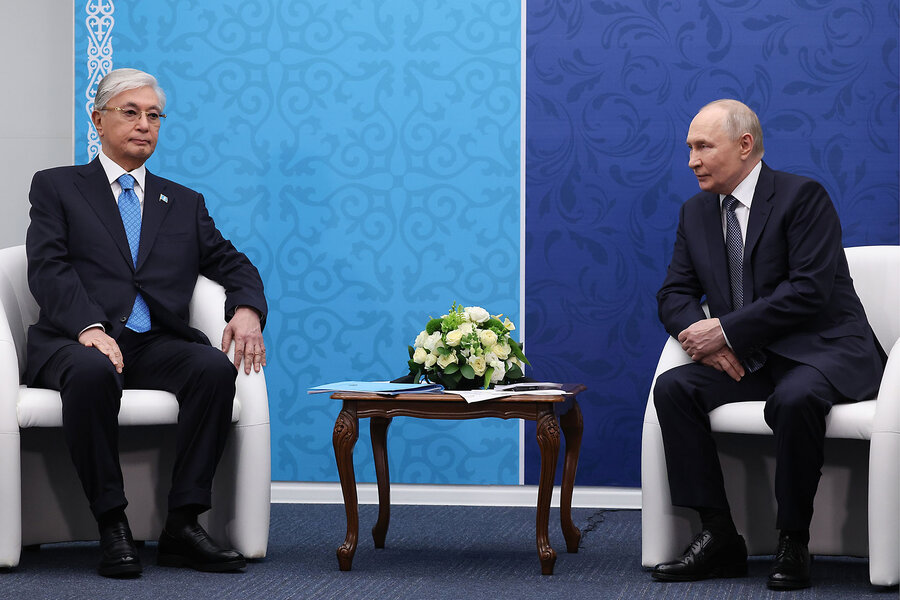
Why former Soviet states now challenge Russia over Ukraine war
Former Soviet states in Central Asia are questioning Russia’s war with Ukraine
Places named in this report: Beijing, Moscow
Exact coordinates
beijing: 39.900, 116.400
moscow: 55.760, 37.620
Read it at The Christian Science Monitor See this on the map
What might happen next? AI-generated
These scenarios are written by an AI language model from the headline and summary above. They are not predictions from the newsroom, and they are not evidence of anything. Every one is given a deadline and checked against later coverage, and the score is published on the ledger — including the ones that miss.
-
Unresolved 40% Cautious Diplomatic Outreach
A coalition of Central Asian nations decides to formally open bilateral dialogues with Western capitals, signaling a shift away from Russian reliance. This outreach is framed as a search for economic alternatives amid instability. Russia responds with a public condemnation but agrees to a limited security consultation with one key state.
Watch for: A joint statement from Kazakhstan and Turkey regarding regional security interests is published. · The Russian Foreign Ministry issues a press release regarding the 'illegal' nature of the dialogue.
-
Unresolved 30% Immediate Economic Pivot
The economic pressure from the war accelerates the decision by multiple states to seek non-aligned energy and trade deals with China and India. This rapid diversification effectively undercuts Russia's regional leverage within two weeks. Russia responds by increasing its military presence along its southern borders.
Watch for: An MOU is signed between a Central Asian state and a major Chinese energy firm (e.g., CNPC) unrelated to Russian contracts. · The Russian Ministry of Defense announces a 'readiness exercise' near the disputed border.
-
Unresolved 20% Internal Russian Reassertion
Russia dismisses the concerns of former Soviet states as 'Western-inspired propaganda' and doubles down on its strategic partnership narrative. Russia offers significant, non-conditional infrastructure investment to a specific state, making the cost of dissent prohibitively high. The push for Western alternatives stalls.
Watch for: Russia announces a multi-billion dollar 'Solidarity Infrastructure Package' for a specific Central Asian nation. · A Russian state media broadcast features a high-level official directly addressing the 'unreliability' of Western guarantees.
-
Unresolved 10% Sudden Regional Alignment (Counter-Intuitive)
Facing immediate external economic coercion rather than ideological pressure, the Central Asian states form a unified bloc to support Russia's current strategic positioning. They publicly sign a declaration reinforcing their historical security ties to Moscow. This sudden alignment shocks international observers.
Watch for: The heads of the governments of at least two different Central Asian nations convene an emergency, undisclosed meeting and release a joint press release endorsing 'regional stability' as defined by Moscow. · The US State Department issues a special briefing questioning the recent 'recalibration' of diplomatic stances in Central Asia.
Generated by gemma-4-E4B-it-qat-UD-Q4_K_XL.gguf
on 2026-08-13. Checked against later coverage after 2026-08-23.
See how these forecasts score.
ForecastGeo shows the headline and summary published by the newsroom and places the story on a map. The full article lives at the source.