Why Chinese foreign minister’s trip to South Korea ‘dealt a low blow’ to Seoul
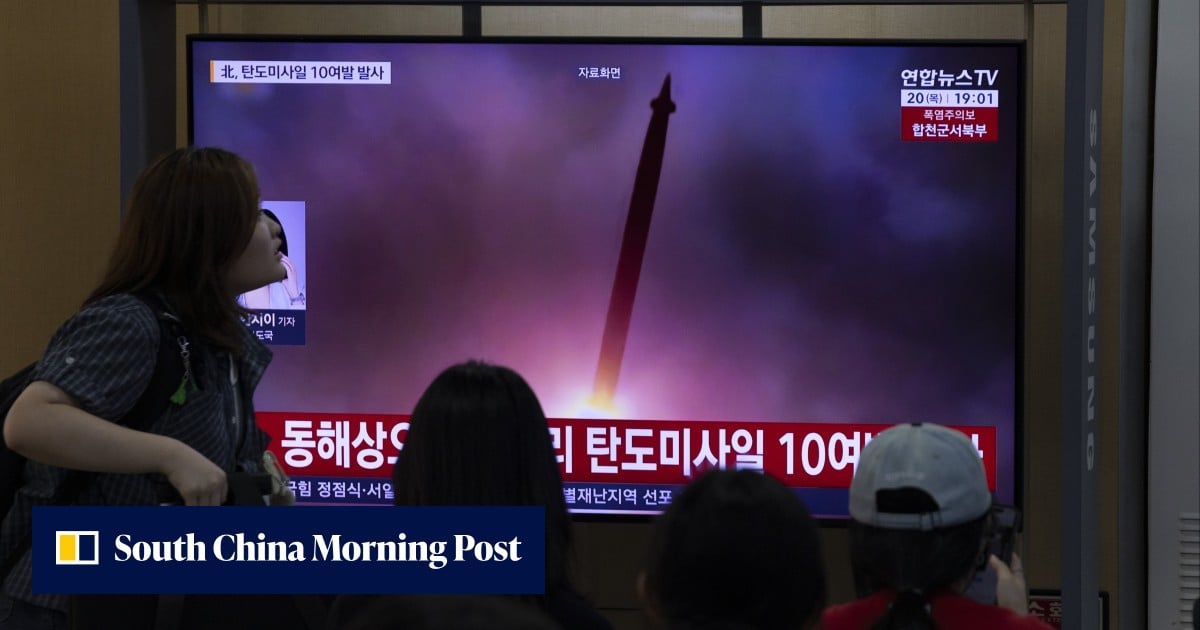
China’s top diplomat, Wang Yi, concluded his visit to South Korea on Friday, but declined to back Seoul’s push for multiparty peace talks involving the North. His two‑day trip, which followed President Xi Jinping’s first visit to Pyongyang in seven years in June, coincided with US President Donald Trump’s decision to scale back joint military exercises with South Korea and call for further talks with the North. North Korea, however, responded with more than 10 short-range ballistic missile...
Places named in this report: Seoul, Washington, Beijing
Exact coordinates
seoul: 37.570, 126.980
washington: 38.910, -77.040
beijing: 39.900, 116.400
Read it at South China Morning Post See this on the map
What might happen next? AI-generated
These scenarios are written by an AI language model from the headline and summary above. They are not predictions from the newsroom, and they are not evidence of anything. Every one is given a deadline and checked against later coverage, and the score is published on the ledger — including the ones that miss.
-
Unresolved 45% Tense Standoff Continues
The immediate diplomatic stalemate persists as both sides react to the missile tests without significant new concessions. North Korea continues its rapid military posturing, while Seoul remains committed to its multilateral peace framework, leading to increased regional diplomatic friction.
Watch for: South Korea issues a formal diplomatic rebuke of North Korea's latest missile test within 3 days. · US Department of State releases a statement reiterating support for the existing military exercises.
-
Unresolved 30% US-China Mediation Breakthrough
The US and China find a discrete off-ramping mechanism to prevent immediate conflict, potentially linking US military restraint to Chinese backing of limited dialogue. This prevents further immediate military escalation while preserving underlying disagreements.
Watch for: US and Chinese officials hold an unpublicized bilateral meeting within the next 14 days. · South Korean Foreign Ministry confirms a shift in its approach to North Korean engagement without naming specific demands.
-
Unresolved 15% Sudden De-escalation via Technical Talks (Counter-intuitive)
Overwhelmed by the immediate risk of kinetic conflict following the missile tests, North Korea abruptly signals a willingness to halt testing for 72 hours to allow for technical discussions, possibly catalyzed by internal pressure or a private backchannel.
Watch for: North Korean state media broadcasts a temporary suspension of missile testing with a specific, non-political justification. · A South Korean military official announces a 'low-level technical exchange' with Pyongyang.
-
Unresolved 10% Divergence and Increased Isolation
The lack of progress causes Pyongyang to double down on unilateral military action, while Seoul pulls back from broader regional diplomatic initiatives, focusing entirely on immediate security assurances from the US, leading to a period of heightened regional tension.
Watch for: North Korea launches a follow-up, higher-capability missile test within 10 days. · South Korea announces a formal review of its current defense posture in a press conference.
Generated by gemma-4-E4B-it-qat-UD-Q4_K_XL.gguf
on 2026-08-22. Checked against later coverage after 2026-08-27.
See how these forecasts score.
ForecastGeo shows the headline and summary published by the newsroom and places the story on a map. The full article lives at the source.