Why are South Korean football fans choosing European clubs over the K League?
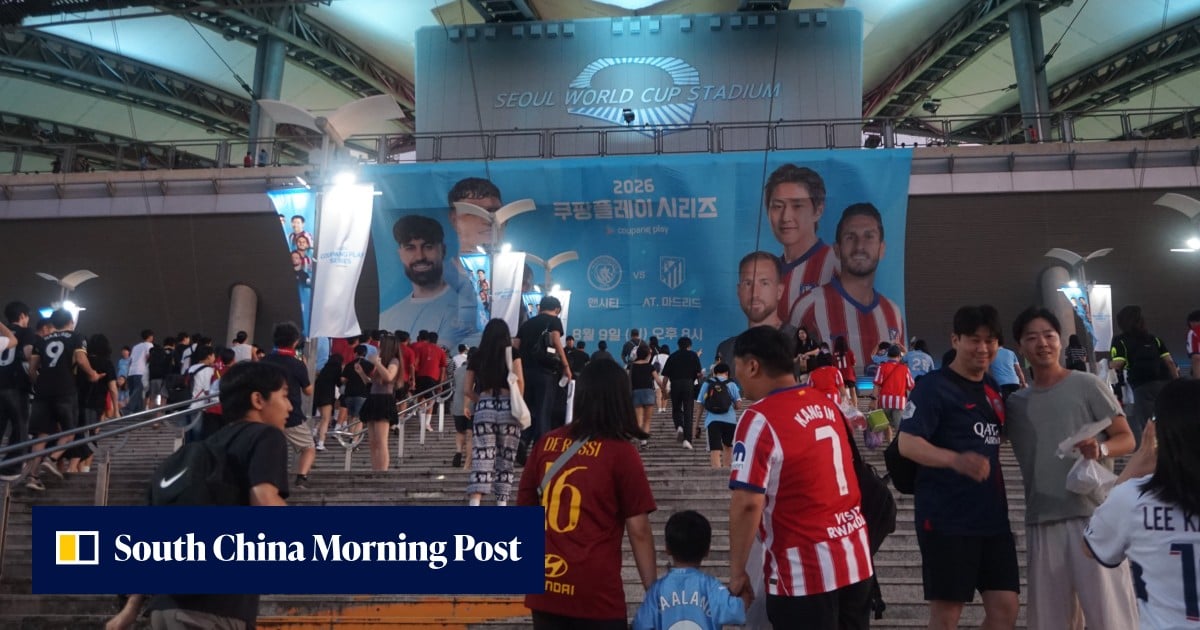
Yoon Jin-woo had never gone to Seoul World Cup Stadium to watch FC Seoul, the city’s team and the club that calls South Korean football’s symbolic home its own. But on Sunday night, he made the pilgrimage from the suburbs of Gimpo to see Manchester City and Atletico Madrid, two European clubs whose pull in South Korea rivals, and often overwhelms, interest in the domestic game. The 21-year-old and his friends were among 50,000 fans who filled the stadium with City’s light blue and Atletico’s...
Places named in this report: Seoul, Madrid
Exact coordinates
seoul: 37.570, 126.980
madrid: 40.420, -3.700
Read it at South China Morning Post See this on the map
What might happen next? AI-generated
These scenarios are written by an AI language model from the headline and summary above. They are not predictions from the newsroom, and they are not evidence of anything. Every one is given a deadline and checked against later coverage, and the score is published on the ledger — including the ones that miss.
-
Unresolved 40% K League Marketing Surge
The K League, facing a genuine threat, launches an aggressive, highly visible marketing blitz targeting Gen Z. This campaign successfully bundles premium fan experiences with high-profile domestic talent showcases, drawing significant immediate attention away from foreign matches.
Watch for: K League announces a 'Global Fan Experience' partnership with a major tech company within 7 days. · A domestic K League match features a major celebrity guest making a public appearance at the stadium.
-
Unresolved 30% Fan Trend Solidification
The trend of prioritizing European clubs becomes a permanent subculture among younger, affluent fans. This leads to a noticeable shift in the demographic purchasing season tickets for local clubs, forcing them to adapt their branding.
Watch for: A major K League club releases a social media campaign explicitly acknowledging the popularity of European football. · Ticket sales reports from the K League reveal a 15% drop in average attendance at domestic fixtures compared to the previous month.
-
Unresolved 20% Official Regulatory Intervention
The national sports governing body takes swift action to address the perceived 'brain drain' of domestic interest. They mandate increased media airtime for domestic leagues during prime viewing slots, effectively subsidizing local exposure.
Watch for: The Korea Football Association (KFA) issues a public directive requiring broadcasters to prioritize K League coverage. · A government official attends a K League press conference to discuss 'national sporting integrity'.
-
Unresolved 10% Counter-Intuitive Domestic Boom (The Wildcard)
A major, highly publicized international transfer of a top Korean talent to a European giant causes a massive, emotional wave of national pride. This unexpected event galvanizes the domestic fanbase, leading to a sudden surge in local interest and media coverage.
Watch for: A major Korean player signs a contract extension or transfer to a globally recognized European club. · Seoul World Cup Stadium sells out for an unexpected local derby match within one week.
Generated by gemma-4-E4B-it-qat-UD-Q4_K_XL.gguf
on 2026-08-11. Checked against later coverage after 2026-08-18.
See how these forecasts score.
ForecastGeo shows the headline and summary published by the newsroom and places the story on a map. The full article lives at the source.