What does a self-reliant South Korea look like? Some push for a nuclear option.
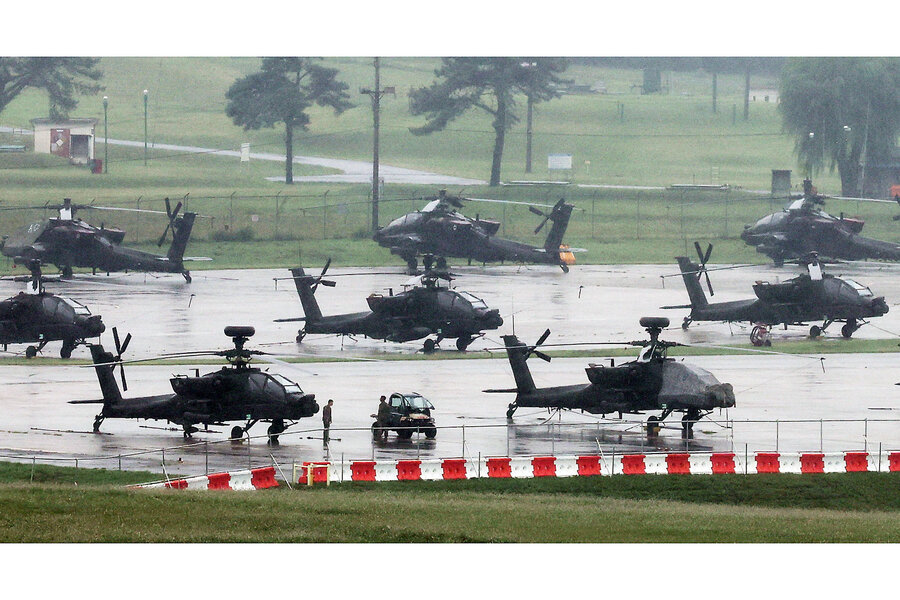
Washington’s curtailing of joint military drills in South Korea was widely framed as a humiliating moment for Seoul. But it could also push the country on a path to self-reliance – and nuclear arms.
Where: Iran, South Korea, Japan, United States, Seoul, Washington, Ukraine
Exact coordinates
iran: 32.430, 53.690
south korea: 35.910, 127.770
japan: 36.200, 138.250
united states: 37.090, -95.710
seoul: 37.570, 126.980
washington: 38.910, -77.040
ukraine: 48.380, 31.170
Read it at The Christian Science Monitor See this on the map
2 outlets covered this story — see how their framing differs
What might happen next? AI-generated
These scenarios are written by an AI language model from the headline and summary above. They are not predictions from the newsroom, and they are not evidence of anything. Every one is given a deadline and checked against later coverage, and the score is published on the ledger — including the ones that miss.
-
Unresolved 40% Increased Pro-Nuclear Push
The perceived abandonment by the US triggers a rapid internal political pivot in Seoul favoring sovereign defense. Key legislative bodies accelerate discussions on nuclear modernization, moving from theoretical debate to concrete policy proposals. This shift is fueled by domestic nationalist sentiment amplified by media coverage of US troop posture.
Watch for: South Korean National Assembly introduces a bill specifically mentioning 'strategic deterrence' in defense procurement. · Minister of Defense holds a public briefing announcing a review of nuclear technology partnerships.
-
Unresolved 35% US Reassurance Through Military Pact
Faced with the potential for instability, the US administration intervenes diplomatically to prevent an arms race. Washington offers a new, high-level security consultation framework with Seoul, effectively replacing the cancelled drills with a more robust, advisory commitment. Seoul accepts the framework to avoid escalating tensions.
Watch for: US Secretary of State announces a new, binding 'Strategic Security Dialogue' agreement with Seoul. · A joint press release is issued detailing increased US military advisory units stationed permanently in South Korea.
-
Unresolved 15% Domestic Political Stagnation
The issue gets bogged down in political maneuvering within the South Korean legislature. Opposition parties successfully block any major moves toward nuclear discussion due to public apprehension or bureaucratic inertia. The current security status quo remains unchanged, leading to a temporary lull in the arms debate.
Watch for: South Korean parliamentary committee tables the nuclear policy discussion for a mandatory three-month review period. · The Prime Minister issues a public statement emphasizing adherence to existing US-ROK alliance protocols.
-
Unresolved 10% Rapid Regional De-escalation
A surprise diplomatic breakthrough occurs involving regional powers, effectively neutralizing the immediate impetus for Seoul to seek nuclear autonomy. Pyongyang or a third-party regional actor (like China) offers a significant security guarantee or peace initiative that renders the immediate need for self-reliance obsolete. This unexpected gesture stabilizes the entire Northeast Asian security calculus.
Watch for: A 'Joint Statement on Regional Security' is signed involving South Korea and a neighboring country other than the US or North Korea. · Diplomatic cables indicate a sudden, high-level, unpublicized summit between South Korean and North Korean envoys.
Generated by gemma-4-E4B-it-qat-UD-Q4_K_XL.gguf
on 2026-08-25. Checked against later coverage after 2026-09-04.
See how these forecasts score.
ForecastGeo shows the headline and summary published by the newsroom and places the story on a map. The full article lives at the source.