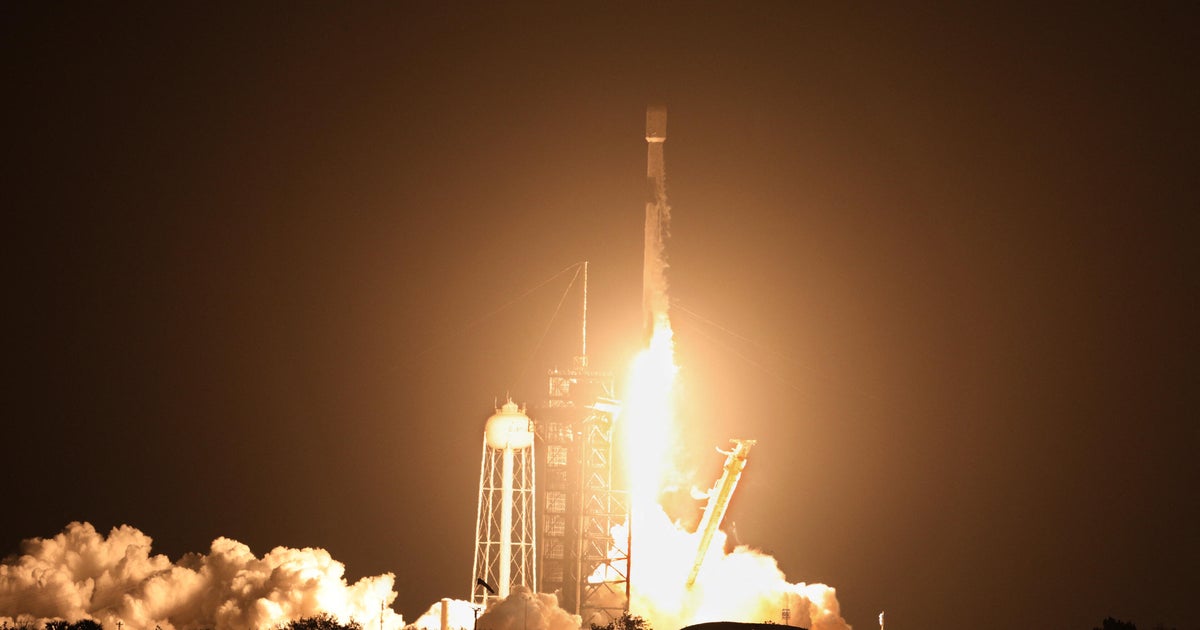
Wayward SpaceX rocket to slam into moon, leave 16-foot deep crater
The impact will not be visible to the naked eye, but photos are expected to come from a lunar satellite at a later time.
Places named in this report: Boston
Exact coordinates
boston: 42.360, -71.060
Read it at CBS News See this on the map
What might happen next? AI-generated
These scenarios are written by an AI language model from the headline and summary above. They are not predictions from the newsroom, and they are not evidence of anything. Every one is given a deadline and checked against later coverage, and the score is published on the ledger — including the ones that miss.
-
Unresolved 45% Routine Scientific Confirmation
The impact occurs as a planned, non-critical test of a new upper-stage system. Subsequent satellite imagery confirms the crater's size and composition, leading to a standard academic publication in a journal like *Nature*. The incident is treated purely as a successful, albeit messy, engineering milestone for SpaceX.
Watch for: NASA's Lunar Reconnaissance Orbiter releases high-resolution imagery showing a new, small impact scar. · A press release from SpaceX announces successful testing of the 'Starship-X' upper stage, citing minor unplanned events.
-
Unresolved 30% Increased Regulatory Scrutiny
The impact sparks an international review regarding the safety protocols of large private launches near celestial bodies. Governments in the US and EU demand greater oversight on space debris and planetary impact risk from commercial entities. This leads to new licensing requirements for future missions.
Watch for: The US Congress holds a bipartisan hearing on 'Off-World Object Safety Standards'. · The European Space Agency releases a formal statement recommending mandatory impact impact mitigation procedures for private entities.
-
Unresolved 15% Geopolitical Tension via Resource Claims
While the crater itself isn't resource-rich, its location becomes politically significant if it falls near a region of contested lunar interest. A rival nation, perhaps China, uses the event to claim sovereign interest in the 'impact zone' for future potential resource mapping, leading to diplomatic friction.
Watch for: A state-owned space agency from a geopolitical rival issues a joint announcement regarding 'monitoring activities' near the impact coordinates. · A US Department of State official issues a public advisory regarding international norms for celestial body exploration.
-
Unresolved 10% Unexpected Scientific Discovery (Counter-Trajectory)
Contrary to expectations of just a crater, the impact triggers a unique geological event. Analysis of the ejecta reveals unexpected concentrations of rare isotopes or ancient lunar material, leading to a sudden, highly publicized breakthrough in planetary science.
Watch for: A scientific paper published in a top-tier journal describes the 'unusual isotopic signature' found within the impact ejecta. · SpaceX CEO hosts a live, global press conference dedicated solely to the unexpected scientific yield of the lunar impact.
Generated by gemma-4-E4B-it-qat-UD-Q4_K_XL.gguf
on 2026-08-04. Checked against later coverage after 2026-08-18.
See how these forecasts score.
ForecastGeo shows the headline and summary published by the newsroom and places the story on a map. The full article lives at the source.