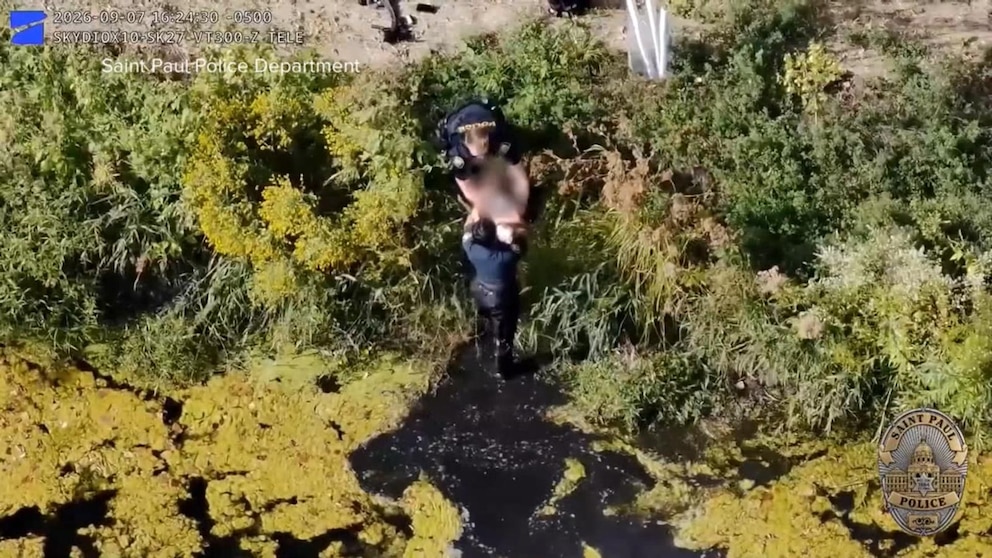
WATCH: Minnesota police drone locates child in pond
When a 911 call came in about a child who appeared to be struggling in a pond, police in St. Paul, Minnesota used a drone to help locate the boy and speed up the rescue.
Places named in this report: Hawaii, Oklahoma, Ohio, Minnesota
Exact coordinates
hawaii: 19.900, -155.580
oklahoma: 35.560, -97.520
ohio: 40.420, -82.910
minnesota: 46.730, -94.690
Read it at ABC News See this on the map
What might happen next? AI-generated
These scenarios are written by an AI language model from the headline and summary above. They are not predictions from the newsroom, and they are not evidence of anything. Every one is given a deadline and checked against later coverage, and the score is published on the ledger — including the ones that miss.
-
Unresolved 45% Rapid Public Safety Adoption
Following the successful rescue, local city councils and police unions in Minnesota begin an immediate, informal review of the technology's cost-effectiveness. This leads to immediate, low-level procurement discussions for adding similar drone capabilities to other St. Paul patrol units within the next two weeks.
Watch for: St. Paul City Council holds an emergency public forum specifically discussing drone procurement for emergency services within 7 days. · A Minnesota police union issues a statement endorsing the immediate expansion of drone usage in non-combat rescue operations.
-
Unresolved 30% Privacy Pushback and Regulatory Halt
The incident sparks a highly publicized debate over police surveillance creep, with civil liberties groups filing an immediate legal injunction against the police department regarding drone footage retention policies. This forces the city to pause all new drone acquisitions pending a legal review.
Watch for: Civil Liberties Union (or similar group) files a lawsuit against the St. Paul Police Department citing First Amendment concerns regarding drone data logging. · The St. Paul Police Chief issues a public statement announcing a temporary moratorium on using drone footage for non-critical incidents.
-
Unresolved 15% Technological Skepticism and Return to Basics
Despite the success, skepticism remains high among veteran dispatchers and field officers who question the reliability of the drone's sensors in varied conditions. A low-level internal memo suggests relying on traditional search and rescue methods until a more robust, government-approved hardware standard is established, effectively sidelining the technology for now.
Watch for: The St. Paul Police Department's internal memo to the Fire Marshal announces a temporary reliance on manual search teams over drone deployment for similar rescues. · A local news segment features an interview with a retired first responder criticizing the drone's battery life in the initial search.
-
Unresolved 10% Unforeseen Media Distraction (Counter-Trajectory)
The positive story is completely overshadowed by a separate, unrelated incident in the same news cycle, such as a major traffic accident or political scandal. This diversion ensures that the drone technology gains virtually no institutional momentum or regulatory attention beyond the initial news cycle.
Watch for: ABC News publishes a major follow-up story on a completely different local political controversy within 36 hours, with minimal mention of the drone's role. · The St. Paul Police Department issues a standard, non-specific 'thank you' tweet, rather than a detailed technological briefing or expansion plan.
Generated by llama
on 2026-09-10. Checked against later coverage after 2026-09-17.
See how these forecasts score.
ForecastGeo shows the headline and summary published by the newsroom and places the story on a map. The full article lives at the source.