‘War without battle’: Europe struggles to tackle mounting Russian hybrid attacks
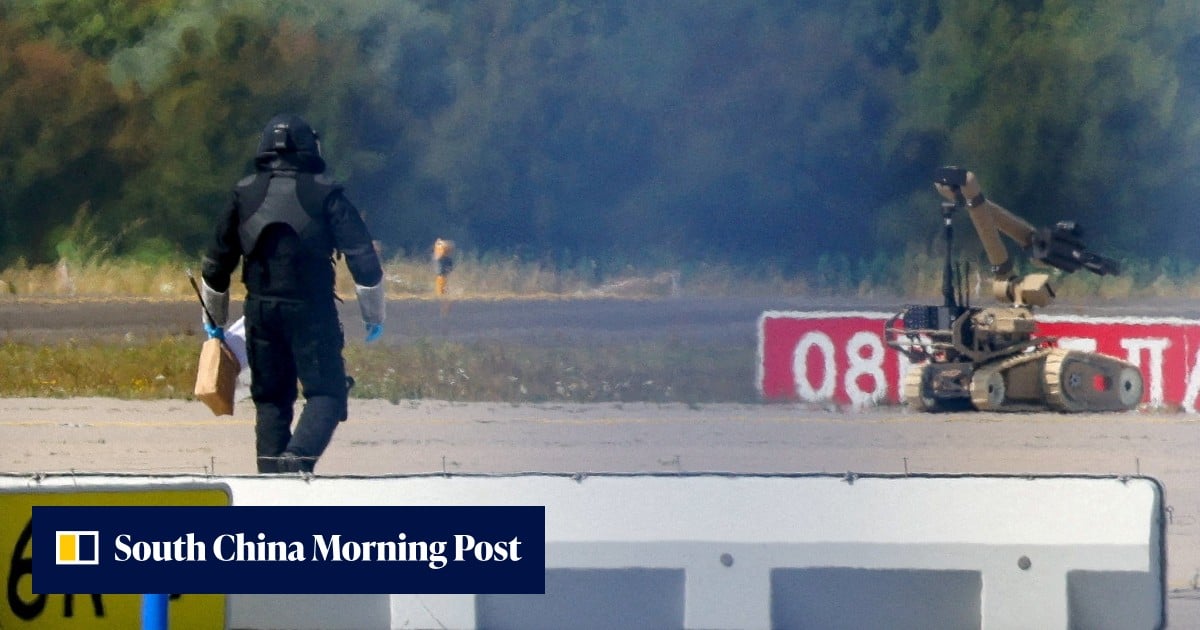
Over the course of the summer, Russian attacks have been pushing ever deeper into European territory. On August 11, military divers destroyed two drones floating off the coast of Romania near a €4 billion (US$4.7 billion) energy project. Nine days later, Bucharest scrambled two F-16s to take out a maritime drone near the same Black Sea gas platform with hundreds of workers on board. Earlier that month, German police detected an armed UAV at Leipzig airport, while this week Nato jets downed...
Exact coordinates
ukraine: 48.380, 31.170
moscow: 55.760, 37.620
Read it at South China Morning Post See this on the map
What might happen next? AI-generated
These scenarios are written by an AI language model from the headline and summary above. They are not predictions from the newsroom, and they are not evidence of anything. Every one is given a deadline and checked against later coverage, and the score is published on the ledger — including the ones that miss.
-
Awaiting deadline 30% Immediate Military Response
NATO decides to issue a specific public condemnation and authorize increased air patrols. This action signals a shift from passive defense to active deterrence, forcing Russian hybrid attacks to pause to avoid immediate retaliation. The heightened alert status in Romania leads to a visible, high-profile joint NATO exercise near the Black Sea.
Watch for: NATO announces a new, permanent air defense deployment along the Black Sea coast · Romania publicly upgrades its military alert status to 'DEFCON 3'
-
Awaiting deadline 35% Local Deterrence Buildup
Focus shifts from large-scale NATO maneuvers to highly visible, localized defense measures at critical infrastructure points. Energy project operators in Romania and Germany install more advanced, internationally sourced counter-drone technology. A diplomatic push fails to de-escalate, leaving the immediate security status quo but with hardened targets.
Watch for: The German federal government announces subsidies for immediate deployment of electronic warfare systems at high-value targets · A specific European energy company announces the signing of a security partnership with a defense firm
-
Awaiting deadline 20% Counter-Hybrid Incursion
This is the less likely scenario that runs counter to the obvious trajectory. Instead of increasing defensive measures, the West responds by conducting a targeted, non-kinetic counter-action. A coordinated information warfare counter-campaign is launched against Russian narratives surrounding the attacks. This causes a temporary lull in physical attacks as the aggressor faces immediate digital backlash.
Watch for: A major EU intelligence agency releases a joint report detailing the operational structure of the Russian drone networks · Russian state media issues a specific denial regarding the validity of recent Western intelligence
-
Awaiting deadline 15% Diplomatic De-escalation Attempt
Amidst the attacks, a third-party mediator (e.g., a neutral nation or EU body) successfully brokers a short-term 'no-fly zone' agreement over specific maritime areas. This temporary truce allows workers at the €4 billion energy project to return to normal operations. The immediate threat is downgraded from 'active war' to 'managed risk'.
Watch for: The EU Council announces a specific, limited maritime ceasefire agreement valid for 72 hours · The United Kingdom publicly announces the participation of its diplomatic channels in a new negotiation
Generated by llama
on 2026-09-17. Checked against later coverage after 2026-09-24.
See how these forecasts score.
ForecastGeo shows the headline and summary published by the newsroom and places the story on a map. The full article lives at the source.