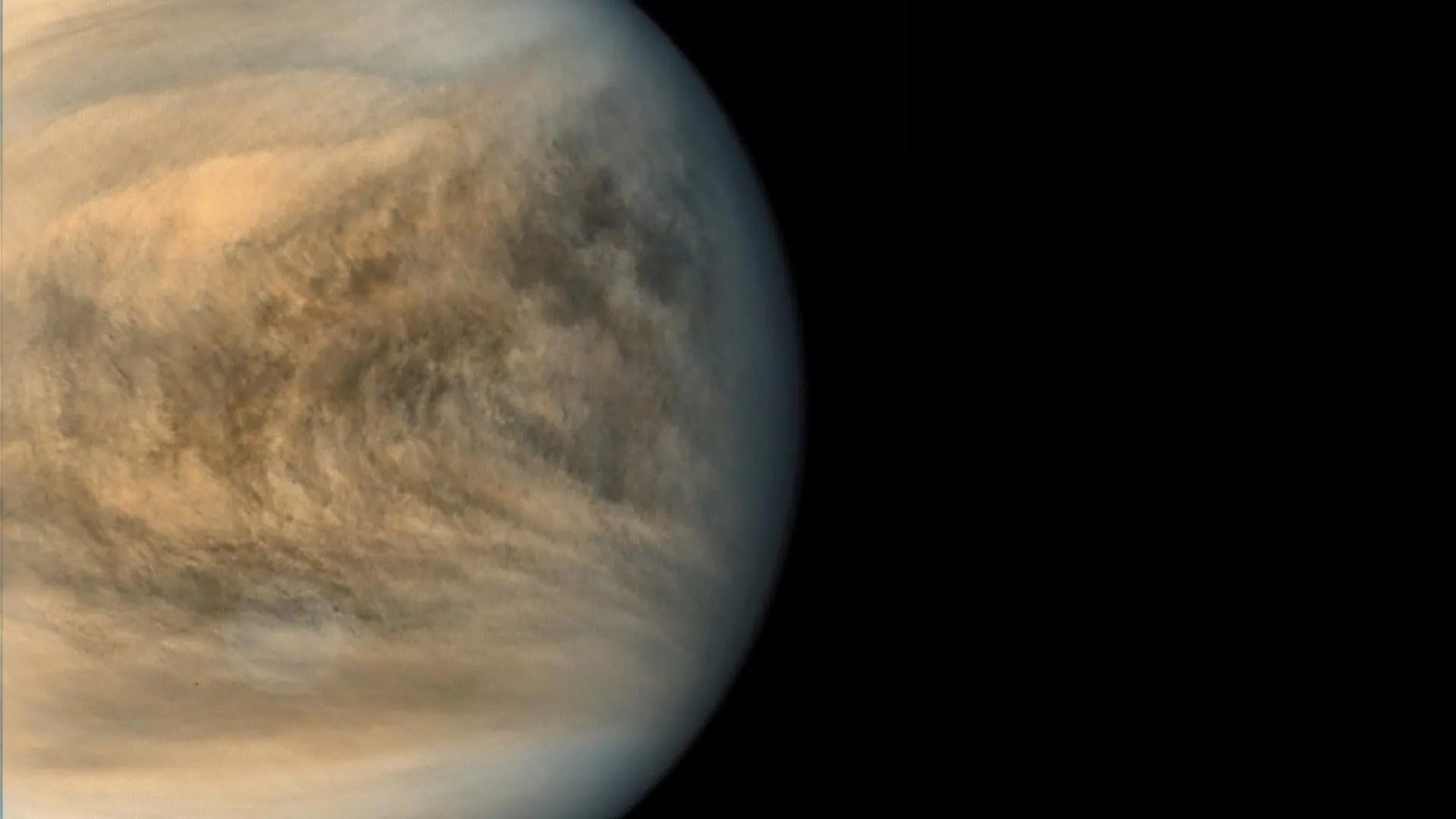
Venus’s pale yellow clouds may hide something surprisingly dark
A century-old mystery in Venus’s clouds just became more intriguing, as scientists calculated how strongly the unidentified material behind its dark ultraviolet patterns must absorb light. The results sharply narrow the possibilities and could help future spacecraft determine whether the mysterious substance is organic, inorganic, or something unexpected.
Where: Poland
Exact coordinates
poland: 51.920, 19.150
Read it at ScienceDaily See this on the map
What might happen next? AI-generated
These scenarios are written by an AI language model from the headline and summary above. They are not predictions from the newsroom, and they are not evidence of anything. Every one is given a deadline and checked against later coverage, and the score is published on the ledger — including the ones that miss.
-
Awaiting deadline 35% Expedited Mission Launch Approval
The compelling new data from the Venus cloud study garners immediate, high-level support from international space agencies. Governments fast-track the necessary funding and regulatory hurdles to greenlight a dedicated, high-resolution probe mission. This decision sets a firm timeline for future exploration.
Watch for: NASA/ESA issues a joint press release announcing a fast-track approval for the Venus Cloud Investigation Mission.
-
Awaiting deadline 30% Scientific Re-evaluation Stalling
The complexity and ambiguity of the new absorption calculations lead to internal debate among leading astrophysicists. Peer review processes become bogged down in methodological critiques, delaying a unified conclusion on the substance's nature. The scientific community remains divided on the implications of the findings.
Watch for: The Journal of Astrobiology publishes a rebuttal paper citing methodological flaws in the original absorption calculation.
-
Awaiting deadline 20% Contingent Data Acquisition Focus
Instead of focusing on the unknown material's nature, the scientific community shifts resources to correlate the new data with existing atmospheric models. They determine if the absorption patterns correspond to known, albeit rare, atmospheric compounds. This narrows the mystery but avoids a major discovery.
Watch for: A specialized study published in Science confirms that the absorption pattern matches known trace atmospheric sulfur compounds.
-
Awaiting deadline 15% Paradigm Shift - Non-Scientific Focus
An unlikely, non-academic body, such as a private defense contractor or an obscure government agency, interprets the data through a purely strategic lens. They claim the 'dark' material suggests an unusual atmospheric hazard or potential resource, triggering immediate, albeit low-profile, governmental inquiries. This ignores the organic/inorganic debate entirely.
Watch for: A defense contractor releases a white paper titled 'Venus Atmospheric Anomalies: Potential Strategic Implications' to industry analysts.
Generated by llama
on 2026-09-13. Checked against later coverage after 2026-09-23.
See how these forecasts score.
ForecastGeo shows the headline and summary published by the newsroom and places the story on a map. The full article lives at the source.