Tiny sound waves could help solve a major quantum computing problem
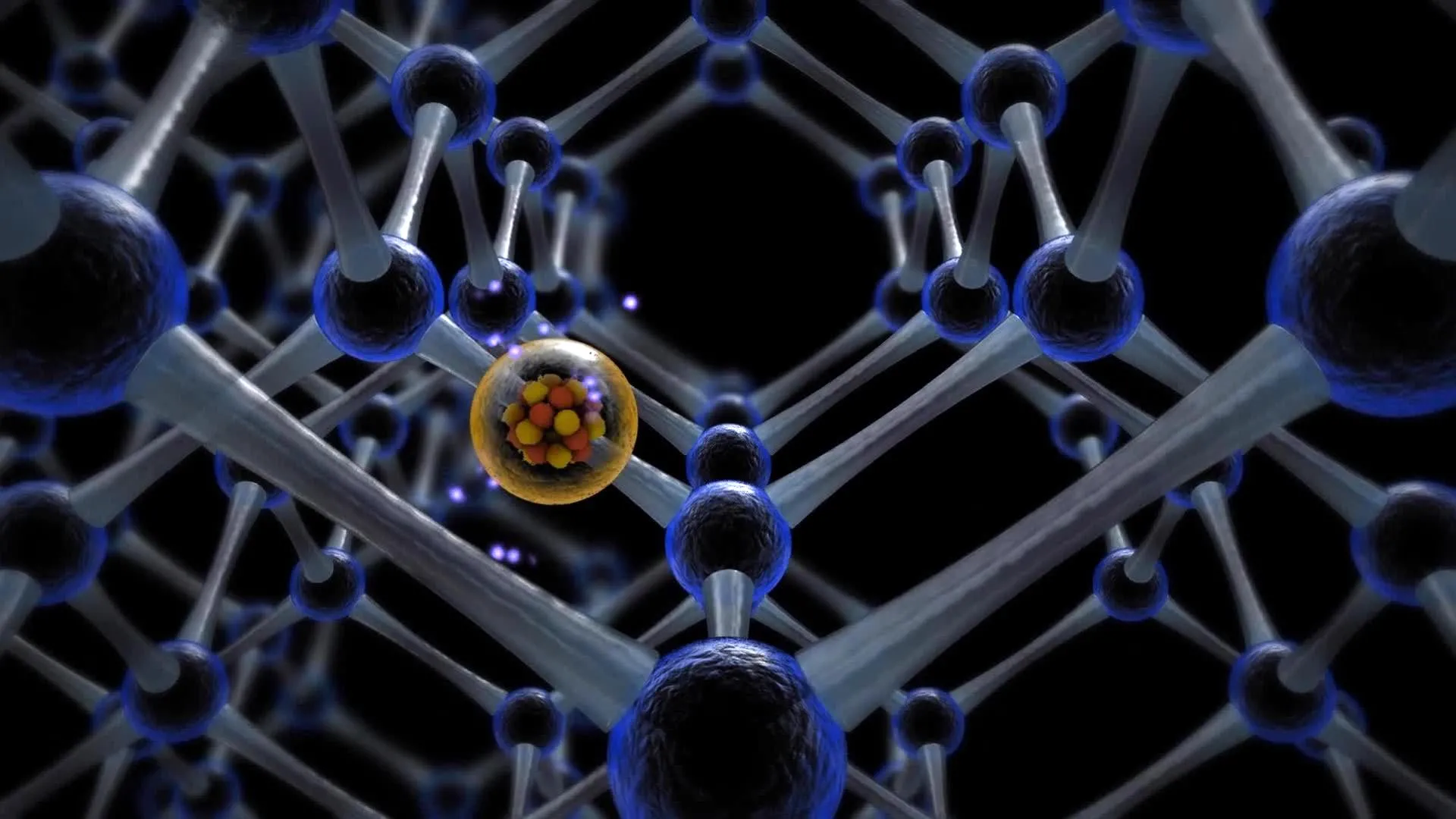
Researchers at Harvard have demonstrated a way to protect quantum information using microscopic sound waves. By continuously surrounding a diamond-based qubit with mechanical vibrations, they extended its coherence time by roughly threefold. The same phonons could eventually both transmit and protect quantum information, opening the door to compact sound-based quantum networks on chips.
Places named in this report: Boston
Exact coordinates
boston: 42.360, -71.060
Read it at ScienceDaily See this on the map
What might happen next? AI-generated
These scenarios are written by an AI language model from the headline and summary above. They are not predictions from the newsroom, and they are not evidence of anything. Every one is given a deadline and checked against later coverage, and the score is published on the ledger — including the ones that miss.
-
Unresolved 50% Immediate Peer Validation
The Harvard team presents their findings to a top international physics conference. A major competitor, like Google or IBM, immediately announces a public partnership with a leading acoustics firm, validating the application of sound-based phonon technology in quantum hardware.
Watch for: Harvard researchers publish a peer-reviewed preprint on arXiv within 3 days. · A major tech company issues a statement confirming an investment in phonon-based quantum networking.
-
Unresolved 30% Internal Scientific Refinement
The initial demonstration is met with skepticism regarding scalability and environmental noise. The Harvard team releases a technical white paper detailing the energy efficiency requirements for the sound-wave protection, shifting the focus from proof-of-concept to practical engineering hurdles.
Watch for: The Harvard lab publishes a detailed 'Technical Limitations' report alongside the initial paper. · A university engineering department announces a joint grant focused specifically on chip-scale phonon fabrication.
-
Unresolved 15% Sudden Commercial Pivot (Counter-Intuitive)
Instead of focusing on the complex quantum mechanics, a venture capital firm recognizes the potential of the *sound wave* protection itself. They announce a startup focused solely on using acoustic damping for next-gen telecommunications, completely bypassing the quantum computing aspect.
Watch for: A VC firm announces funding for a startup with a name referencing 'Acoustic Quantum Shield'. · The company's first product demo features sound-wave insulation for server racks, not qubits.
-
Unresolved 5% Academic Replication Failure
Independent labs attempt to replicate the exact parameters of the Harvard experiment but fail to match the threefold coherence extension. The initial excitement fades as the community awaits a clear, reproducible protocol, stalling further immediate investment.
Watch for: A lab at MIT or Caltech publishes a follow-up paper stating 'Replication of Harvard's Phonon Extension Yield Failed'. · A major grant application for quantum computing receives a 'Conditional' status pending independent verification.
Generated by llama
on 2026-09-12. Checked against later coverage after 2026-09-19.
See how these forecasts score.
ForecastGeo shows the headline and summary published by the newsroom and places the story on a map. The full article lives at the source.