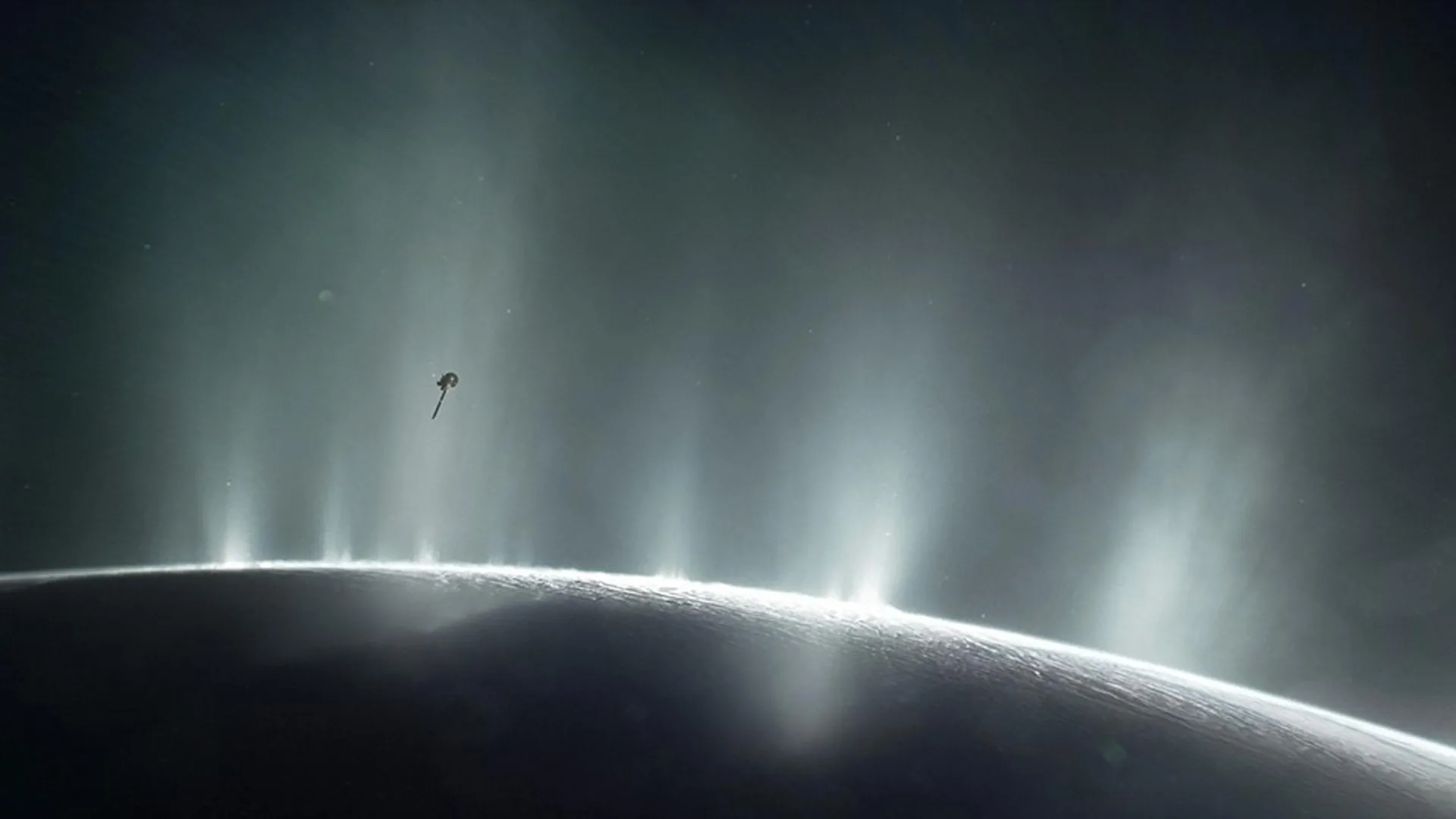
The ice blasting from Saturn's moon Enceladus is stranger than scientists realized
Enceladus may naturally separate and concentrate chemicals from its hidden ocean as droplets slowly freeze and shatter on their way into space. The process could explain Cassini’s puzzling ice-grain chemistry while giving future spacecraft a powerful advantage in searching for organic compounds and clues to life.
Exact coordinates
tokyo: 35.680, 139.690
berlin: 52.520, 13.410
Read it at ScienceDaily See this on the map
What might happen next? AI-generated
These scenarios are written by an AI language model from the headline and summary above. They are not predictions from the newsroom, and they are not evidence of anything. Every one is given a deadline and checked against later coverage, and the score is published on the ledger — including the ones that miss.
-
Awaiting deadline 45% Rapid Scientific Validation
The newly hypothesized ice blasting mechanism is quickly adopted by the scientific community to explain historical data. A major research institution publishes a peer-reviewed paper confirming the mechanism's physical plausibility within the short term.
Watch for: Major astrophysics journal publishes paper titled 'Enceladus Ice Fragmentation Dynamics Confirmed' · NASA's Jet Propulsion Laboratory issues press release acknowledging the 'shattering droplet' hypothesis
-
Awaiting deadline 25% Instrument Redesign Acceleration
The realization of a powerful new search method for organics drives immediate hardware changes for future missions. Agencies fast-track funding and begin preliminary design reviews for next-generation sensors tailored to detect these unique chemical signatures.
Watch for: ESA announces a 3-month expedited timeline for 'Enceladus Life Detection' instrument development · US Congress allocates emergency funding for new deep-space sensor prototyping
-
Awaiting deadline 15% Controversial Skepticism Emerges
The mechanism, while intriguing, faces immediate and intense scrutiny from established planetary scientists who challenge the proposed physical models. A prominent skeptic publishes a detailed rebuttal in a high-impact science forum, calling the hypothesis 'speculative'.
Watch for: Planetary scientist Dr. [Specific Name] publishes rebuttal titled 'Challenging the Enceladus Shatter Model' · Scientific consortium issues a statement requesting further observational data before accepting the mechanism
-
Awaiting deadline 15% Unexpected Mission Pivot (Counter-Trajectory)
Instead of focusing on the mechanism, a mission director decides to repurpose a near-term mission (e.g., a probe currently scheduled for Jupiter) to conduct a targeted, immediate survey of Enceladus's plume using existing, less sophisticated instruments. This diverts focus entirely from the new chemical insights.
Watch for: NASA announces a 'Mission Re-tasking Briefing' announcing immediate redirection of a Jupiter-bound probe to Enceladus · Preliminary observational data from the modified probe shows unexpected, high-volume plume activity, overshadowing the chemistry
Generated by llama
on 2026-09-29. Checked against later coverage after 2026-10-06.
See how these forecasts score.
ForecastGeo shows the headline and summary published by the newsroom and places the story on a map. The full article lives at the source.