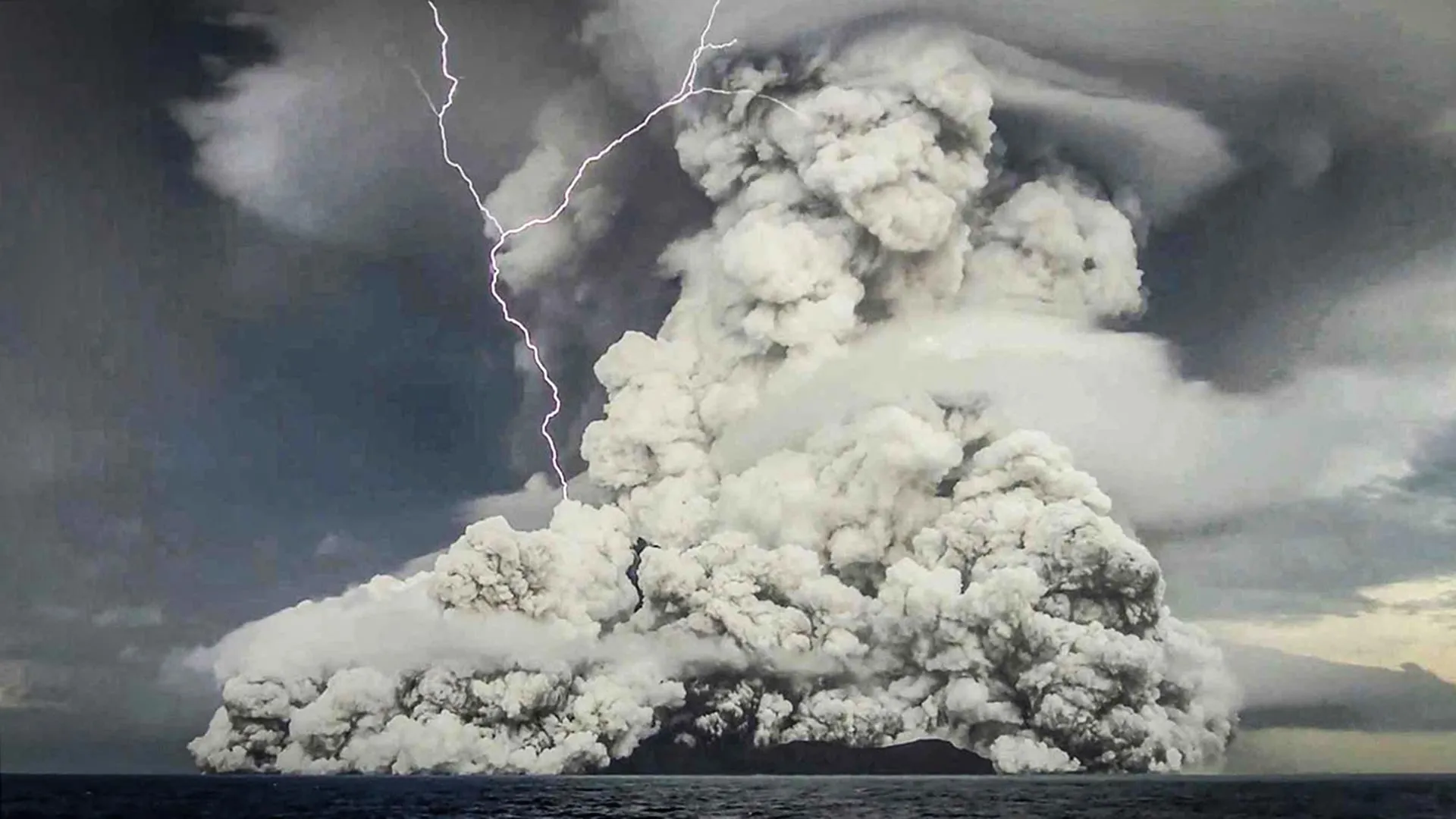
Scientists stunned as volcano cloud starts destroying methane
The Hunga Tonga eruption may have triggered a surprising chemical reaction that destroyed some of the methane released into the atmosphere. Scientists say the discovery could reshape estimates of methane pollution and inspire new methods for slowing near-term global warming.
Places named in this report: Copenhagen
Exact coordinates
copenhagen: 55.680, 12.570
Read it at ScienceDaily See this on the map
What might happen next? AI-generated
These scenarios are written by an AI language model from the headline and summary above. They are not predictions from the newsroom, and they are not evidence of anything. Every one is given a deadline and checked against later coverage, and the score is published on the ledger — including the ones that miss.
-
Unresolved 40% Immediate Scientific Confirmation
The initial study is rapidly replicated by a second independent laboratory. This validates the reaction, leading to immediate global headlines about a potential climate mitigation breakthrough. This triggers a surge in research funding announcements.
Watch for: A major scientific journal publishes a peer-reviewed replication of the Hunga Tonga reaction by a named research group. · A UN climate body issues a press release acknowledging the potential methane destruction mechanism. · Global stock markets show a positive correlation between climate tech investment and the news.
-
Unresolved 30% Skeptical Downscaling
Skeptical environmental groups or competing climate models challenge the data, claiming the observed methane destruction is negligible in the broader atmospheric context. The media coverage shifts from breakthrough to 'interesting but unproven hypothesis,' slowing the immediate impact on policy.
Watch for: A prominent climate skeptic publishes a detailed rebuttal in a major publication (e.g., Nature Climate Change). · A major governmental environmental agency releases a statement questioning the statistical significance of the methane reduction. · A scientific panel convenes specifically to dispute the Hunga Tonga finding.
-
Unresolved 20% Policy Neglect/Distraction
Due to overwhelming global news cycles, the Hunga Tonga finding receives minimal sustained attention from high-level policymakers. While researchers continue their work, no immediate legislative or regulatory changes are announced, leading to a lull in mainstream discourse.
Watch for: A governmental press release lists the Hunga Tonga discovery alongside dozens of other global events with no dedicated focus. · A major international climate summit agenda confirms no new dedicated working group on volcanic methane destruction. · Media analysis indicates a significant drop in daily search volume for 'Hunga Tonga methane' after the first week.
-
Unresolved 10% Counter-Intuitive Catalyst (Counter-Trajectory)
The reaction itself, while destroying some methane, produces a secondary, unexpected byproduct that proves to be a potent greenhouse gas. This shifts the narrative entirely from 'methane mitigation' to 'new atmospheric threat,' causing a brief, panicked period of re-evaluation.
Watch for: An emergency scientific alert is issued by a meteorological service identifying an unexpected atmospheric constituent following the eruption. · A specialized atmospheric chemist announces that the reaction's byproduct has a calculated Global Warming Potential (GWP) higher than methane. · Financial markets see a sharp, immediate correction in assets related to carbon capture technology.
Generated by llama
on 2026-09-15. Checked against later coverage after 2026-09-20.
See how these forecasts score.
ForecastGeo shows the headline and summary published by the newsroom and places the story on a map. The full article lives at the source.