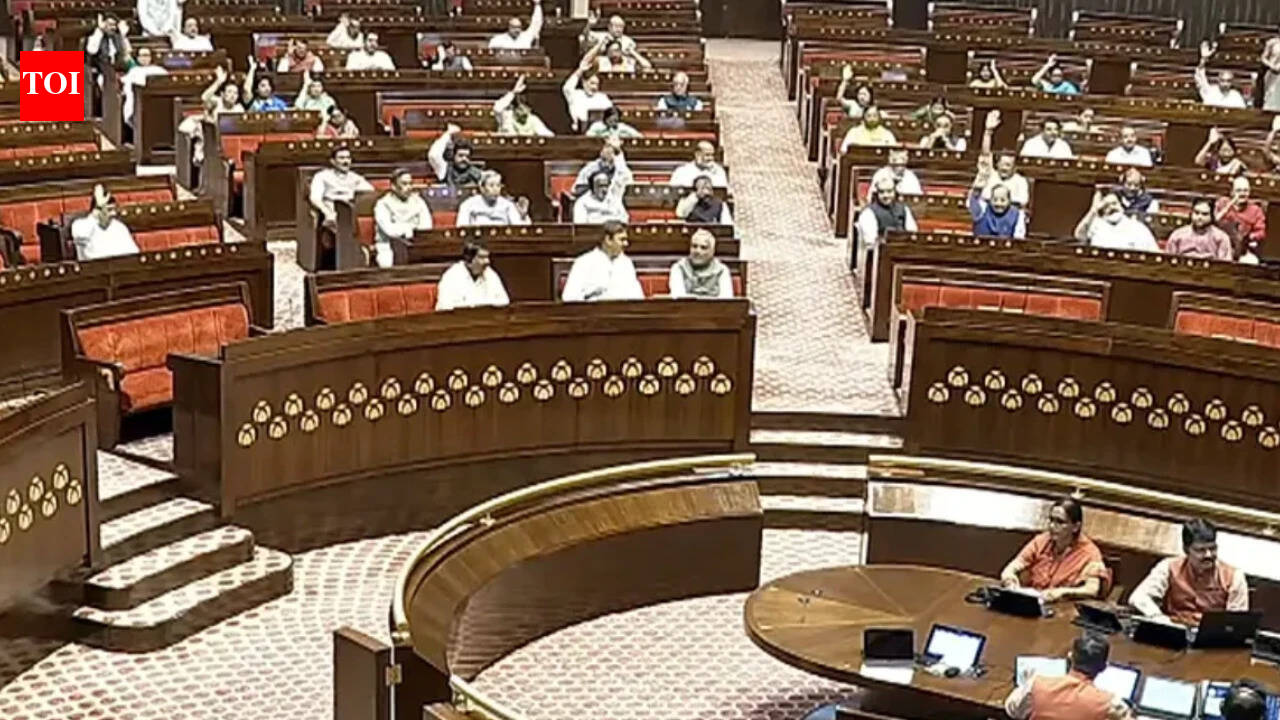
Rajya Sabha passes by voice vote bill to raise Supreme Court judge strength
The Rajya Sabha approved a bill to increase the Supreme Court's judge count. This legislation replaces an ordinance that raised the sanctioned strength to thirty-eight judges. The bill's passage aims to expedite case disposal and enhance judicial efficiency. It will also provide the Chief Justice greater flexibility in forming constitution benches. India anticipates its first woman Chief Justice in the near future.
Exact coordinates
india: 20.590, 78.960
delhi: 28.700, 77.100
Read it at The Times of India See this on the map
2 outlets covered this story — see how their framing differs
What might happen next? AI-generated
These scenarios are written by an AI language model from the headline and summary above. They are not predictions from the newsroom, and they are not evidence of anything. Every one is given a deadline and checked against later coverage, and the score is published on the ledger — including the ones that miss.
-
Unresolved 40% Judicial Acceleration
The increased sanctioned strength immediately leads to faster judicial appointments and case backlogs begin to visibly decrease. The new benches see a measurable reduction in hearing times, fulfilling the bill's primary mandate.
Watch for: The Supreme Court announces the appointment of the first new judges under the 38-member strength · A judicial efficiency report published by a government body cites a 15% reduction in case pendency
-
Unresolved 30% Political Friction and Delays
Opposition parties challenge the process of filling the new seats, leading to legislative gridlock despite the bill's passage. Appointments become contentious, causing internal debates within the judiciary over seniority.
Watch for: A prominent opposition leader files a parliamentary motion questioning the speed of appointments · The Supreme Court issues a public statement detailing the procedural bottlenecks in the appointment process
-
Unresolved 20% Structural Stalemate (Counter-intuitive)
Despite the increased sanctioned strength, the judiciary fails to fill the new vacancies due to external political resistance regarding judicial independence. The system remains under-staffed, and the efficiency gains promised by the bill are not realized.
Watch for: The Chief Justice issues a public directive outlining the lack of progress in filling specific new judge positions · An international judicial monitoring body releases a report noting the continued shortage of judges
-
Unresolved 10% Constitutional Milestone
The increased capacity allows for the successful appointment of the first woman Chief Justice, marking a major social and institutional shift. This event is leveraged by the ruling party to showcase democratic progress.
Watch for: The President of India formally administers the oath to the first woman Chief Justice of India · A major newspaper runs a headline celebrating the judicial diversity achievement
Generated by gemma-4-E4B-it-qat-UD-Q4_K_XL.gguf
on 2026-08-06. Checked against later coverage after 2026-08-20.
See how these forecasts score.
ForecastGeo shows the headline and summary published by the newsroom and places the story on a map. The full article lives at the source.