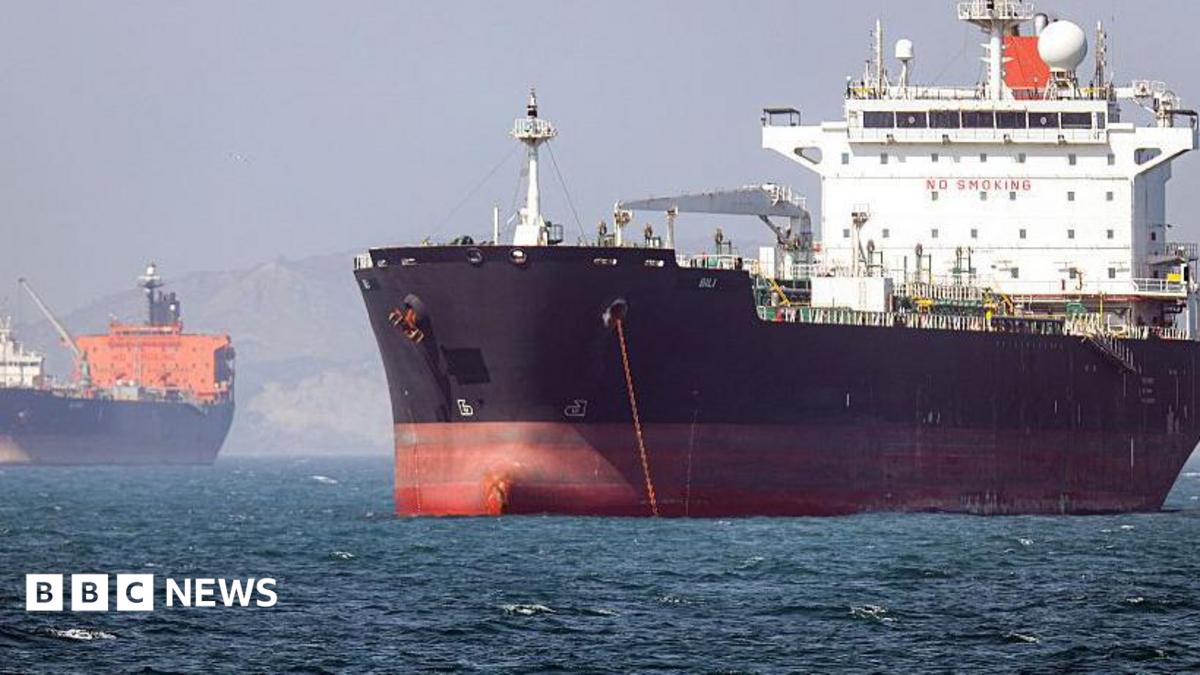
Oil prices fall on hopes Strait of Hormuz could reopen
US Secretary of State Marco Rubio and Treasury Secretary Scott Bessent both announced talks had progressed to allow shipments to resume.
Where: Texas, Iran, Washington
Exact coordinates
texas: 31.970, -99.900
iran: 32.430, 53.690
washington: 38.910, -77.040
Read it at BBC News See this on the map
23 outlets covered this story — see how their framing differs
What might happen next? AI-generated
These scenarios are written by an AI language model from the headline and summary above. They are not predictions from the newsroom, and they are not evidence of anything. Every one is given a deadline and checked against later coverage, and the score is published on the ledger — including the ones that miss.
-
Did not happen 35% Immediate Diplomatic De-escalation
The current diplomatic momentum leads to a rapid, verifiable agreement. Both US and regional actors commit to specific de-escalation benchmarks, allowing shipping to resume under monitored conditions. This validates the initial optimistic reporting and stabilizes global energy markets quickly.
Watch for: The UN Security Council adopts a resolution explicitly sanctioning the resumption of maritime traffic in the Strait of Hormuz. · A joint press release is issued by the US Department of State and the relevant regional maritime authority confirming the reopening timeline.
-
Did not happen 30% Stalled Negotiations and Market Panic
Substantive disagreements over security guarantees or compensation remain unresolved. Talks stall after several rounds, leading to a sudden collapse in confidence among global shippers. Oil prices surge sharply as traders price in the risk of a prolonged blockade.
Watch for: The US Treasury Secretary issues a statement postponing the next round of talks indefinitely. · A major international shipping consortium announces a temporary rerouting of tanker traffic to bypass the Strait.
-
Did not happen 20% Sustained, Low-Intensity Friction
A fragile 'cold peace' is established where official talks continue but no major commitments are made. Minor, non-military incidents occur—such as temporary delays or minor seizures—serving as diplomatic leverage without triggering a full conflict. Shipping operates under high uncertainty.
Watch for: The US Secretary of State announces a technical working group focused solely on 'incident mitigation' rather than broader political agreements. · A named regional naval commander issues a public statement detailing 'increased patrols' without mentioning a blockade.
-
Confirmed 15% Unexpected Regional Military Action (Counter-Trajectory)
Despite the positive signals from Washington, a non-state actor or a secondary regional power decides the diplomatic window is too risky and initiates a surprise, localized military action near the Strait. This undermines the US assurances and immediately halts the momentum.
Watch for: A major international news outlet reports an unidentified vessel engaging in 'contact' with a commercial tanker near the Bab el-Mandeb entrance. · The US State Department issues an emergency briefing citing 'unforeseen security developments' and halting all current negotiation timelines.
Generated by gemma-4-E4B-it-qat-UD-Q4_K_XL.gguf
on 2026-08-04. Checked against later coverage after 2026-08-11.
See how these forecasts score.
ForecastGeo shows the headline and summary published by the newsroom and places the story on a map. The full article lives at the source.