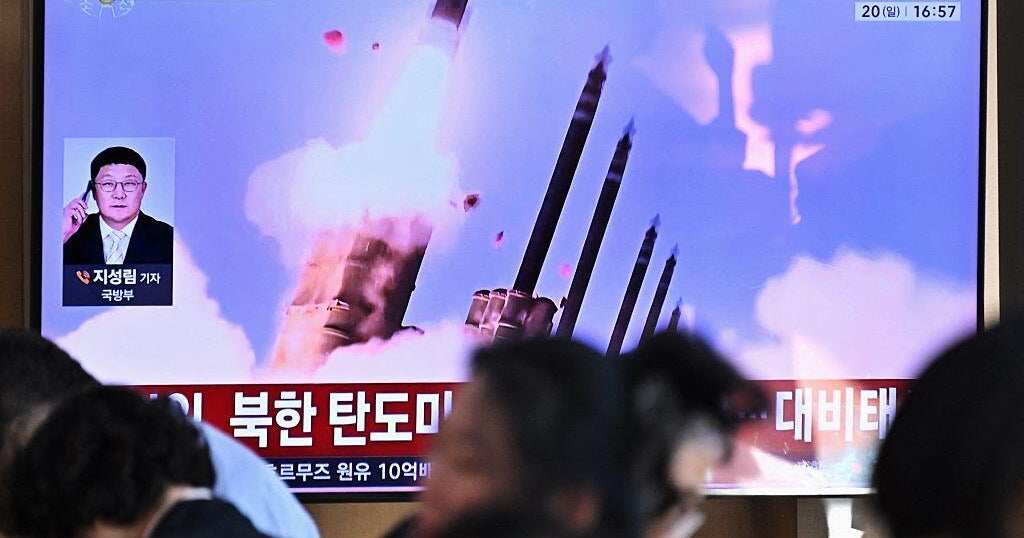
North Korea launches missiles as it dials up pressure against U.S.
The launches came just days after Pyongyang reasserted its status as a nuclear-armed state and rejected a U.N. resolution demanding it halt its nuclear activities.
Where: New Zealand, Australia, Iran, South Korea, Japan, United States, Canada
Exact coordinates
new zealand: -40.900, 174.890
australia: -25.270, 133.780
iran: 32.430, 53.690
south korea: 35.910, 127.770
japan: 36.200, 138.250
united states: 37.090, -95.710
canada: 56.130, -106.350
Read it at CBS News See this on the map
3 outlets covered this story — see how their framing differs
What might happen next? AI-generated
These scenarios are written by an AI language model from the headline and summary above. They are not predictions from the newsroom, and they are not evidence of anything. Every one is given a deadline and checked against later coverage, and the score is published on the ledger — including the ones that miss.
-
Awaiting deadline 30% Diplomatic De-escalation
Following the missile launches, the immediate fear of conflict triggers back-channel communication between Washington and Pyongyang. A high-level, unnamed envoy is dispatched to Seoul to facilitate a secret meeting between the two capitals. This meeting results in a public, though vague, joint statement affirming a commitment to stability.
Watch for: A U.S. State Department official publicly announces secret talks are underway with Pyongyang. · A joint communiqué is released by both North Korea and the U.S. outlining mutual commitment to dialogue.
-
Awaiting deadline 30% Increased Rhetoric and Further Testing
Pyongyang interprets the U.S. reaction to the missile tests as a sign of weakness or indecision. In response to the international condemnation, North Korea conducts another, more sophisticated missile test within the 14-day window to solidify its perceived status.
Watch for: Pyongyang officially announces a second missile launch within the next 14 days. · North Korean media broadcasts a declaration citing U.S. 'weak' reaction as justification for further tests.
-
Awaiting deadline 25% Unforeseen Internal U.S. Policy Shift
Domestic political pressure within the U.S. shifts abruptly, leading to a surprise executive order that mandates a 72-hour moratorium on any military exercises near North Korean borders. This unexpected policy change creates a temporary window of uncertainty and potential negotiation leverage.
Watch for: A White House Press Secretary announces a sudden, temporary halt to U.S. military drills near the DMZ. · A U.S. Congressional subcommittee issues a statement questioning current foreign policy toward DPRK.
-
Awaiting deadline 15% Sudden, Unexpected Regional Truce (Counter-Trajectory)
Against the backdrop of escalating tensions, a highly improbable event occurs: a mid-level North Korean military commander unexpectedly agrees to an immediate, localized ceasefire in a specific border area. This unexpected move is leveraged by regional powers like China and Russia to broker a very limited, temporary lull in tensions.
Watch for: South Korean military reports an unannounced, localized ceasefire along a specific section of the border. · A Chinese Foreign Ministry official issues a statement praising 'recent de-escalation efforts' without explicitly naming the parties.
Generated by llama
on 2026-09-20. Checked against later coverage after 2026-09-27.
See how these forecasts score.
ForecastGeo shows the headline and summary published by the newsroom and places the story on a map. The full article lives at the source.