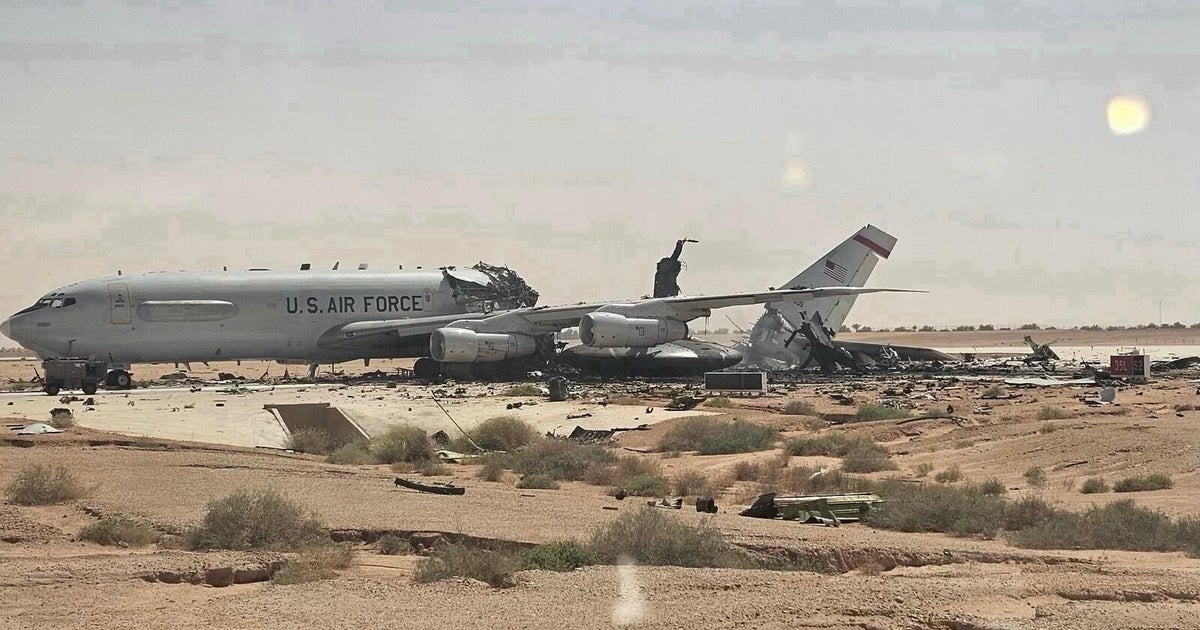
New photos show widespread damage at U.S. positions caused by Iranian attacks
The images were sent to CBS News by active service members under condition of anonymity.
Places named in this report: Saudi Arabia, Iran, Iraq
Exact coordinates
saudi arabia: 23.890, 45.080
iran: 32.430, 53.690
iraq: 33.220, 43.680
Read it at CBS News See this on the map
What might happen next? AI-generated
These scenarios are written by an AI language model from the headline and summary above. They are not predictions from the newsroom, and they are not evidence of anything. Every one is given a deadline and checked against later coverage, and the score is published on the ledger — including the ones that miss.
-
Did not happen 35% Rapid Retaliation
The visible damage at US positions triggers immediate, high-level anger in Washington, leading to a swift and decisive military response against Iranian assets. This retaliation is not necessarily a full-scale invasion but a significant, measurable strike. The US government will use the incident to justify an escalation that forces Iran into a defensive posture.
Watch for: The US Department of Defense publicly announces a 'defensive strike' targeting specific Iranian military infrastructure. · Iran issues a public statement confirming receipt of a US response and citing 'unprovoked aggression'.
-
Did not happen 30% Measured De-escalation
Despite the visual evidence, the US administration chooses to downplay the severity of the damage to avoid an immediate military rush. Instead, they convene a high-level meeting with diplomatic allies to issue stern warnings. This buys time for the diplomatic track to be tested without an immediate shooting in the foot.
Watch for: The US Secretary of State holds a televised press conference explicitly calling for 'restraint and de-escalation' in the region. · A designated US military commander issues an order for 'enhanced defensive readiness' instead of offensive action.
-
Confirmed 20% Diplomatic Intervention
Regional powers (like Turkey or UAE) step in as intermediaries, leveraging their relationships with both Washington and Tehran. They push for emergency backchannel talks mediated by a neutral third party. This path avoids direct confrontation while addressing the immediate security concerns.
Watch for: A named regional diplomat or official from a neutral country is reported as meeting with both US and Iranian representatives. · A joint statement from the mediating country calls for a 48-hour ceasefire to allow 'dialogue to resume'.
-
Did not happen 15% Internal Political Maneuvering
Counter-intuitively, the incident does not prompt an immediate military response. Instead, the US political establishment focuses on the internal political fallout. Congressional leaders or domestic political rivals use the damage photos to challenge the current administration's handling of regional security. The situation stalls due to domestic bickering.
Watch for: A specific member of the US Congress files a formal, high-profile inquiry or resolution regarding the incident. · The White House releases a briefing stating that the focus is currently on 'assessing the long-term strategic impact' rather than 'immediate kinetic action'.
Generated by llama
on 2026-09-16. Checked against later coverage after 2026-09-23.
See how these forecasts score.
ForecastGeo shows the headline and summary published by the newsroom and places the story on a map. The full article lives at the source.