NASA, Energy Department Advance New Era of Nuclear-Powered Exploration
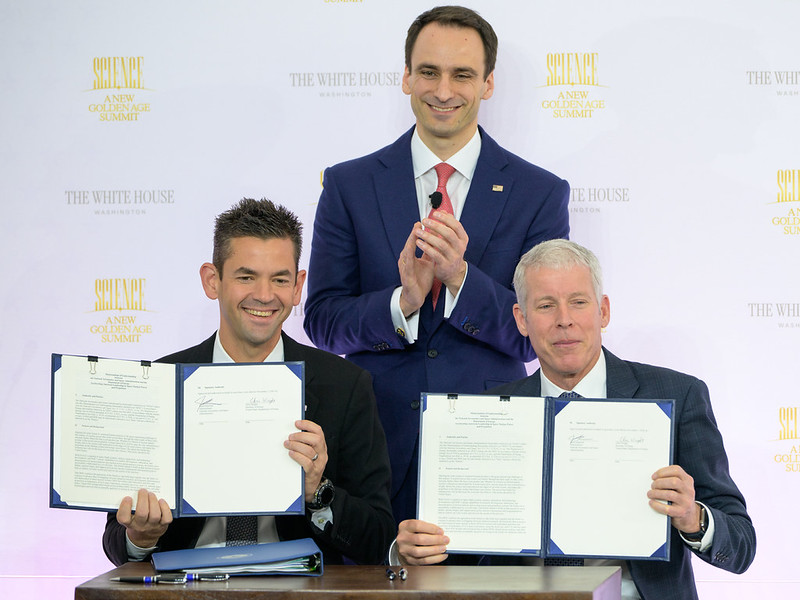
As the Golden Age of deep-space exploration begins, NASA and the U.S. Department of Energy are advancing the development of safe, reliable, next-generation nuclear technologies for space. Together, the agencies will supercharge civil space exploration, unlock bold scientific discovery, and solidify American leadership in space nuclear power and propulsion. “We are entering the ‘Nuclear NASA-era,’ […]
Where: Washington
Exact coordinates
washington: 38.910, -77.040
Read it at NASA See this on the map
What might happen next? AI-generated
These scenarios are written by an AI language model from the headline and summary above. They are not predictions from the newsroom, and they are not evidence of anything. Every one is given a deadline and checked against later coverage, and the score is published on the ledger — including the ones that miss.
-
Awaiting deadline 40% Rapid Regulatory Approval
The synergy between NASA and the Department of Energy proves highly effective, leading to the immediate streamlining of the safety protocols for the next-gen nuclear tech. A major demonstration project is green-lit with expedited permitting, allowing for immediate testing phases. This move solidifies the 'Nuclear NASA-era' vision within the immediate operational cycle.
Watch for: The Department of Energy issues an executive order establishing a dedicated rapid-review task force for space nuclear technology deployment. · A press release confirms the funding tranche for the first advanced nuclear propulsion test has been fully released.
-
Awaiting deadline 30% International Scrutiny & Delays
Global competitors, particularly China or Russia, voice public concerns regarding the safety and proliferation risks of the technology. These concerns lead to a temporary halt in the next phase of development while international safety reviews are conducted. The project pivots toward greater transparency, resulting in a public joint statement with an international nuclear body.
Watch for: A representative from the International Atomic Energy Agency (IAEA) is invited to conduct an on-site safety audit of the DOE facility. · The U.S. State Department releases a joint briefing with a non-aligned nation addressing nuclear technology export controls.
-
Awaiting deadline 15% Internal Bureaucratic Gridlock (Counter-Trajectory)
Despite the ambitious goals, internal bureaucratic friction between NASA and the Department of Energy stalls progress. Disagreements arise over the division of responsibility for risk assessment and testing liabilities. A high-level congressional hearing is scheduled where both agencies fail to present a unified front, resulting in a temporary administrative deadlock.
Watch for: A congressional subcommittee hearing is convened with conflicting testimony from NASA and DOE officials on liability clauses. · A memo is leaked detailing a disagreement over the project's budget allocation versus technical timelines.
-
Awaiting deadline 15% Commercial Sector Acceleration
The promise of reliable space nuclear power attracts private investment before the government fully ramps up its own infrastructure. A private aerospace firm announces a partnership to integrate the technology into a commercial satellite constellation, bypassing some of the slower government testing phases.
Watch for: A private space company, such as SpaceX or Blue Origin, announces a joint Memorandum of Understanding (MOU) with a DOE division. · An accredited financial news service reports a 20% increase in venture capital funding specifically for nuclear-powered space startups.
Generated by llama
on 2026-10-08. Checked against later coverage after 2026-10-15.
See how these forecasts score.
ForecastGeo shows the headline and summary published by the newsroom and places the story on a map. The full article lives at the source.