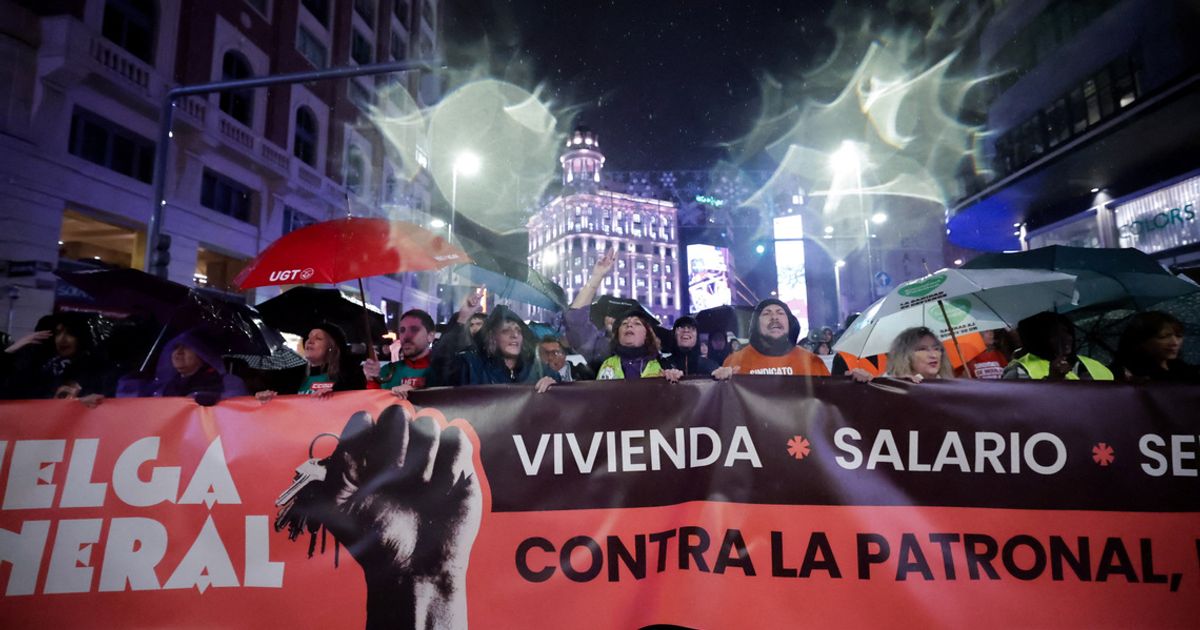
Millions of Spaniards stage first general strike in 14 years as anger over housing leads to clashes
The average rental price is equivalent to about 98.7% of a young person’s monthly salary in Spain.
Places named in this report: Madrid
Exact coordinates
madrid: 40.420, -3.700
Read it at The Straits Times See this on the map
What might happen next? AI-generated
These scenarios are written by an AI language model from the headline and summary above. They are not predictions from the newsroom, and they are not evidence of anything. Every one is given a deadline and checked against later coverage, and the score is published on the ledger — including the ones that miss.
-
Awaiting deadline 40% Government concessions and strike call-off
Within days, the Spanish government announces a package of measures targeting the rental crisis—such as rent controls in stressed areas or new social-housing funding—and frames it as a response to the strikers' demands. Labour unions and the opposition agree to suspend further action, officially ending the strike, which is widely reported as a political win for the government in a fragile coalition context.
Watch for: Spanish Labour Minister announces a new rental cap or housing support package · A major union officially calls off the strike after a second round of talks · The governing coalition publishes a joint statement on housing measures
-
Awaiting deadline 30% Escalation into further strikes and clashes
Talks collapse with no concessions, and protest organizers announce a second wave of strikes that spread to transit, public services, and autonomous regions. Clashes between police and demonstrators worsen, prompting regional governments to demand federal action. The situation hardens, with unions refusing to return to negotiations until concrete housing commitments are made.
Watch for: Transit workers or public-sector workers join a second general strike · Regional governments publicly break with the government on housing policy · Police report mass arrests or injuries at a new protest in a major city
-
Awaiting deadline 18% Factional splintering of the movement
The broad coalition fractures, with moderate unions negotiating separate deals while radical factions reject compromise and keep up isolated protests. Without a single voice, the government can manage the crisis piecemeal, and media attention fades as the movement loses momentum. The general strike fails to produce a unified outcome, and no sweeping reform is delivered.
Watch for: One union signs a separate agreement while another rejects it · Protests shrink in size and geographic spread in the second week · Union leaders issue public statements blaming each other for the split
-
Awaiting deadline 12% Counter-trajectory: hardline crackdown and legal action
Rather than conceding, the government responds to the clashes by pursuing legal or police measures against strike organizers, framing the unrest as a threat to public order. Some union leaders face investigation or charges, and the state mobilizes replacement services to keep the economy running. This reverses the expected trajectory of concession and instead produces a confrontational, state-first stance.
Watch for: Prosecutors or police open an investigation into strike organizers · The government authorizes essential services to continue during the strike · A union leader is formally charged or summoned in connection with clashes
Generated by tiel-coder-35b-a3b-ud-q4_k_xl
on 2026-11-12. Checked against later coverage after 2026-11-19.
See how these forecasts score.
ForecastGeo shows the headline and summary published by the newsroom and places the story on a map. The full article lives at the source.