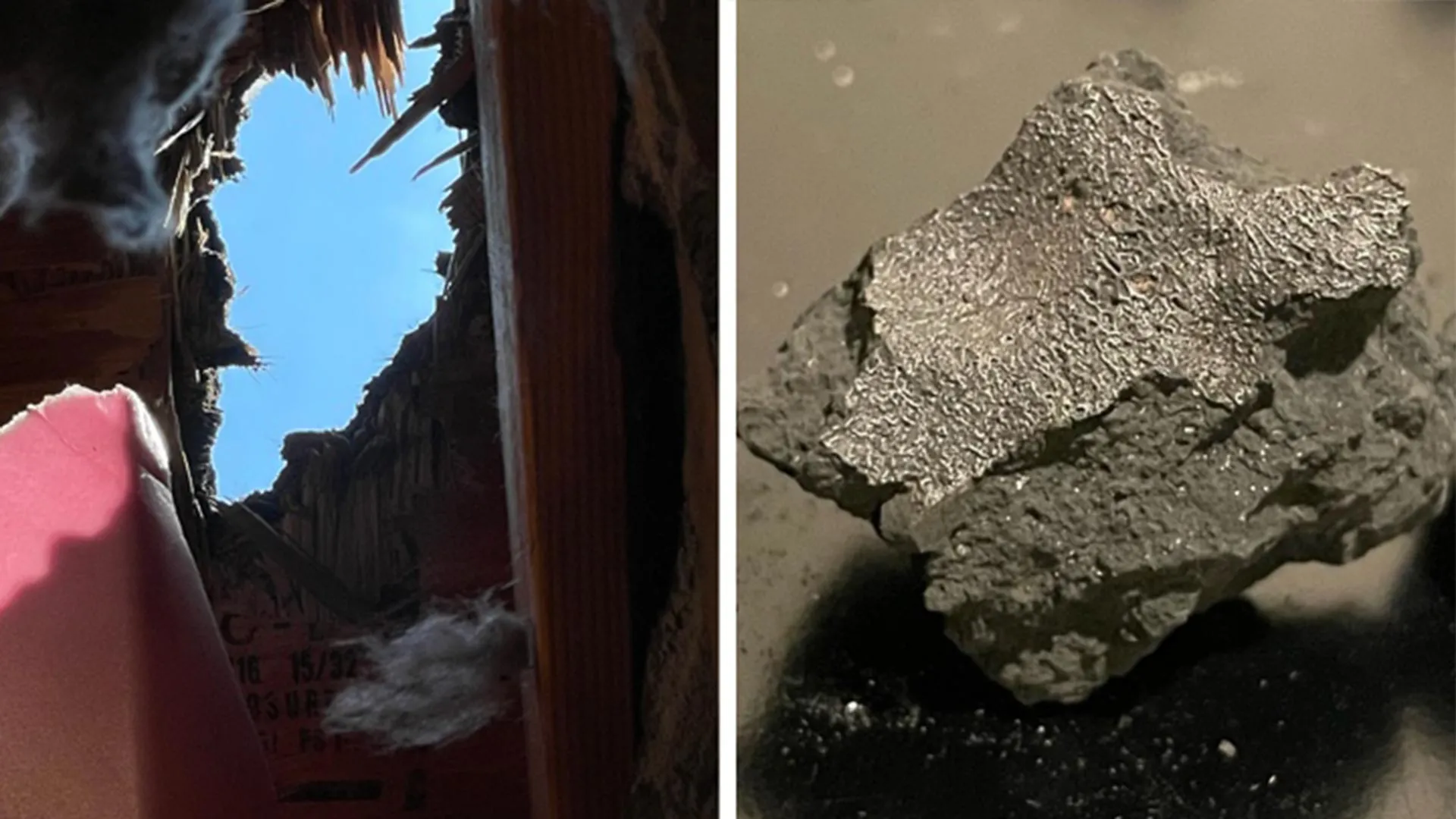
Meteorite that smashed through a New Jersey roof reveals clues to life’s origins
A rare meteorite that crashed through a New Jersey roof contains evidence of ancient salty fluids, organic compounds, and amino acids from a primitive asteroid. Its pristine chemistry could offer new clues about how space rocks helped supply early Earth with some of the ingredients needed for life.
Places named in this report: Houston, New York, London
Exact coordinates
houston: 29.760, -95.370
new york: 40.710, -74.010
london: 51.510, -0.130
Read it at ScienceDaily See this on the map
What might happen next? AI-generated
These scenarios are written by an AI language model from the headline and summary above. They are not predictions from the newsroom, and they are not evidence of anything. Every one is given a deadline and checked against later coverage, and the score is published on the ledger — including the ones that miss.
-
Unresolved 45% Immediate Scientific Breakthrough Announcement
The initial spectroscopic analysis of the meteorite samples yields a definitive, high-resolution identification of a specific prebiotic molecule. This discovery is immediately prioritized by major university press offices, leading to a highly publicized confirmation of the sample's unique origins. Global scientific institutions begin immediate collaborative efforts to replicate the findings.
Watch for: A joint press release is issued by Princeton University and NASA confirming the presence of amino acid precursors. · A peer-reviewed preprint detailing the chemical signature of the meteorite is uploaded to bioRxiv.
-
Unresolved 30% Government-Led Funding Surge
Following the initial New Jersey discovery, a national agency (such as NASA or NSF) swiftly allocates a significant emergency grant to the research team. This influx of capital allows for the immediate deployment of advanced analytical equipment. The focus shifts from basic discovery to high-stakes, large-scale comparative research.
Watch for: The National Science Foundation announces a $X million accelerated grant for 'Astrobiology Sample Analysis'. · A specialized federal lab announces the temporary relocation of the meteorite samples to its secure facility.
-
Unresolved 15% Media Hype Saturation and Public Outreach
The scientific complexity of the findings is rapidly oversimplified by popular media outlets seeking sensational content. The New Jersey location becomes a tourist magnet, and the researchers face intense public scrutiny regarding sample provenance. The primary focus of coverage shifts from chemistry to the 'alien' implications for human history.
Watch for: Local New Jersey authorities announce the establishment of a 'Meteorite Visitor Center' near the original crash site. · A national evening news anchor features an exclusive segment with a popular science commentator speculating on extraterrestrial life.
-
Unresolved 10% Scientific Dead End/Reclassification
Initial high-level analysis proves inconclusive, suggesting the organic compounds are either terrestrial contaminants or non-biogenic analogues that do not fit current models of life's origins. The research team announces a pivot, reclassifying the sample as a geological curiosity rather than a life-source blueprint. The intense initial excitement dissipates into methodical reassessment.
Watch for: The lead researcher releases a statement stating, 'The current data does not support the hypothesis of extraterrestrial biogenic origin at this time.' · The scientific journal specializing in origins of life declines to publish preliminary findings, citing insufficient data.
Generated by gemma-4-E4B-it-qat-UD-Q4_K_XL.gguf
on 2026-08-08. Checked against later coverage after 2026-08-11.
See how these forecasts score.
ForecastGeo shows the headline and summary published by the newsroom and places the story on a map. The full article lives at the source.