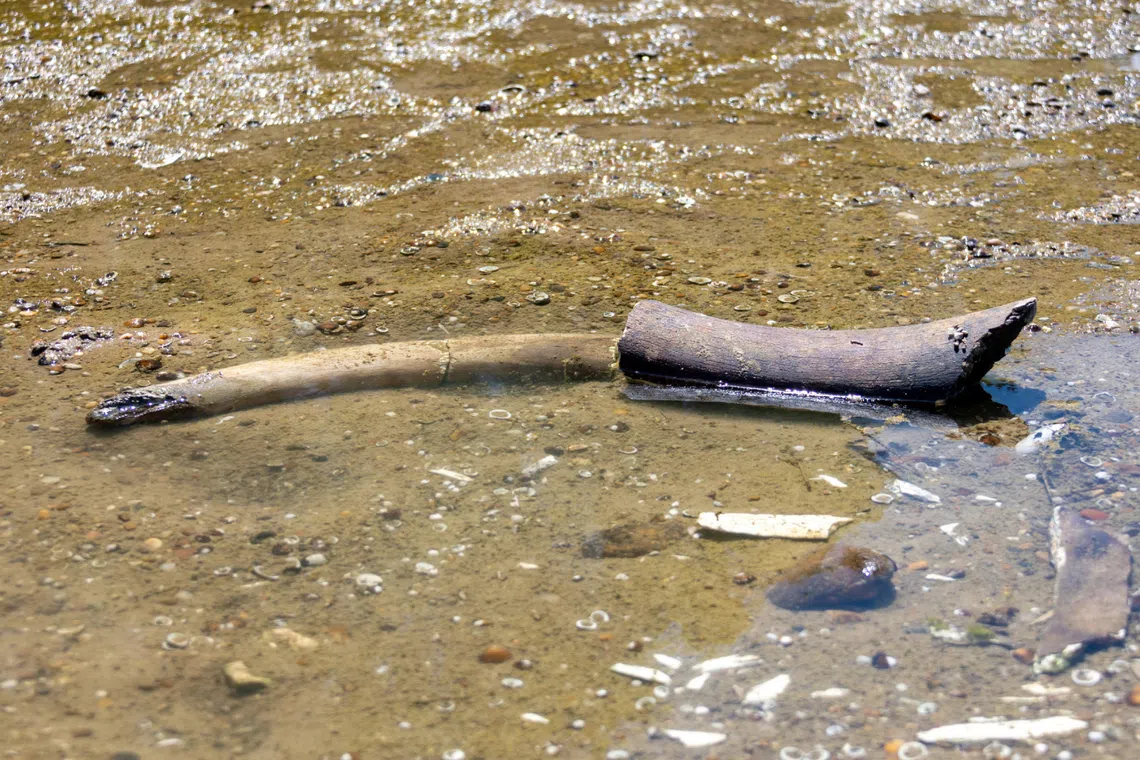
Mammoth bones found on parched bed of Danube in Bulgaria
The bone fragments found near the city of Ruse “very likely” belonged to a woolly mammoth that lived during the Ice Age.
Where: Germany
Exact coordinates
germany: 51.170, 10.450
Read it at The Straits Times See this on the map
What might happen next? AI-generated
These scenarios are written by an AI language model from the headline and summary above. They are not predictions from the newsroom, and they are not evidence of anything. Every one is given a deadline and checked against later coverage, and the score is published on the ledger — including the ones that miss.
-
Unresolved 40% Scientific Breakthrough and Media Frenzy
The discovery garners significant international scientific attention, leading to immediate collaboration between Bulgarian researchers and Western institutions. A major international conference is held in Sofia to present preliminary findings and funding is rapidly secured for further excavation.
Watch for: The Bulgarian Ministry of Culture announces a joint research consortium with a major university from the UK or USA. · A peer-reviewed paper titled 'Anatomical Reconstruction of Pleistocene Megafauna in the Danube Basin' is published in a high-impact journal.
-
Unresolved 30% National Heritage Exploitation
The Bulgarian government leverages the find for national branding and tourism, quickly constructing a high-profile interpretive center near Ruse. This leads to increased national funding for archaeological digs, potentially overshadowing purely academic interest.
Watch for: The Bulgarian National Tourism Agency announces the 'Mammoth Trail' development project near Ruse. · The local municipal budget for Ruse shows a specific capital expenditure allocation for a 'Paleolithic Visitor Center'.
-
Unresolved 15% Counter-intuitive Geological Anomaly Discovery (The Wildcard)
Further carbon dating reveals the bones are not from the Ice Age, but are instead a very recent, highly localized geological intrusion or a hoax. This finding completely derails the scientific narrative and shifts the focus to modern paleoclimatology.
Watch for: A report published by the European Geosciences Union states that the radiocarbon dating places the bone fragments within the last 50 years. · The Bulgarian Academy of Sciences issues a press release contradicting the initial hypothesis of Pleistocene origin.
-
Unresolved 15% Bureaucratic Stagnation and Local Neglect
Despite the initial media hype, the discovery becomes bogged down in administrative red tape, funding cycles stall, and the initial excitement fades into routine site maintenance. The bones are preserved but remain largely under-studied.
Watch for: The designated archaeological site in Ruse is listed on the national inventory but has no active, government-funded excavation permit filed for three consecutive years. · A local news report mentions the site is now maintained by volunteer local groups rather than state-funded researchers.
Generated by gemma-4-E4B-it-qat-UD-Q4_K_XL.gguf
on 2026-07-30. Checked against later coverage after 2026-08-13.
See how these forecasts score.
ForecastGeo shows the headline and summary published by the newsroom and places the story on a map. The full article lives at the source.