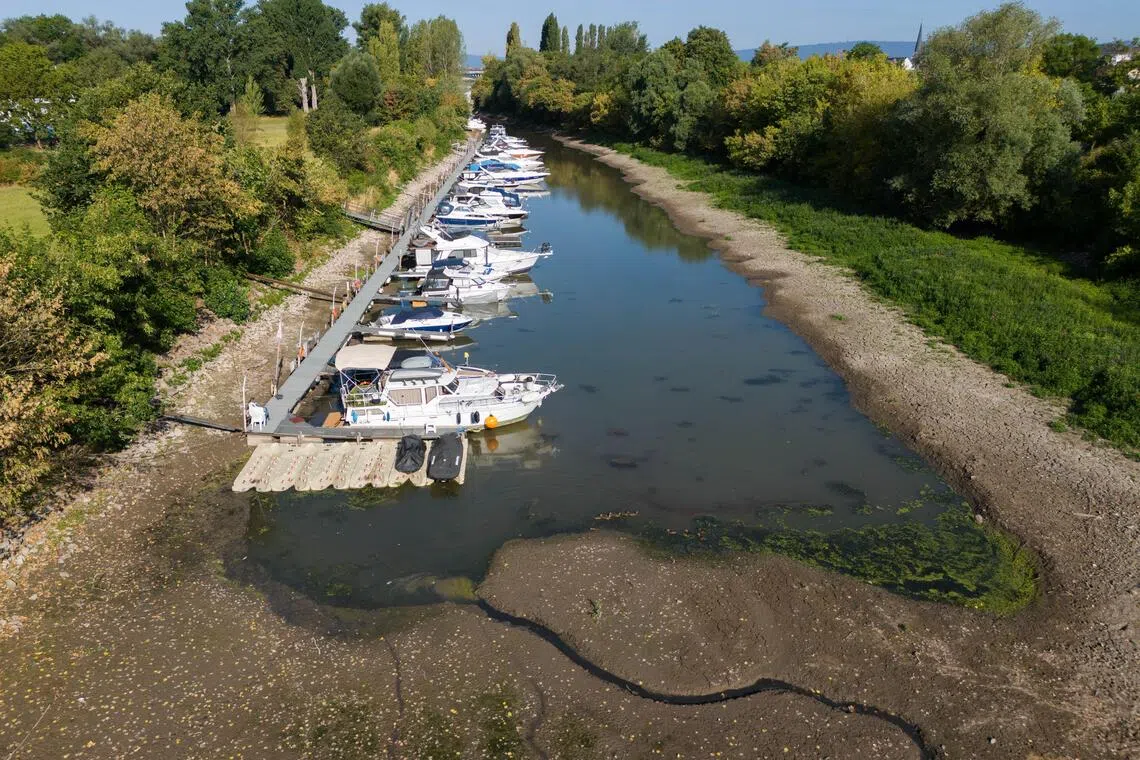
Low water on Germany’s Rhine river threatens new blow to economy
The Rhine river handles around 80 per cent of Germany’s inland waterway traffic, according to an economist.
Where: Germany
Exact coordinates
germany: 51.170, 10.450
Read it at The Straits Times World News See this on the map
What might happen next? AI-generated
These scenarios are written by an AI language model from the headline and summary above. They are not predictions from the newsroom, and they are not evidence of anything. Every one is given a deadline and checked against later coverage, and the score is published on the ledger — including the ones that miss.
-
Awaiting deadline 40% Phased Economic Adaptation
Industry shifts logistics to alternative rail and road networks while regulatory bodies implement temporary shipping restrictions. Major industrial users sign long-term agreements with alternative transport providers.
Watch for: German Federal Ministry of Transport announces a 15% mandated shift in Rhine cargo capacity to rail. · Major German freight companies, such as DB Cargo, report a 20% increase in rail service volume for Rhine-bound goods.
-
Awaiting deadline 30% Emergency International Intervention
Neighboring nations upstream (e.g., Switzerland, Netherlands) initiate coordinated emergency water releases or invest in temporary desalinization infrastructure to maintain minimum navigable levels.
Watch for: A joint statement from the Rhine River Commission detailing coordinated water management protocols across multiple riparian states. · The Dutch Water Board announces the temporary activation of enhanced upstream water release procedures.
-
Awaiting deadline 20% Severe Supply Chain Shock
The logistical bottleneck becomes critical, leading to significant production slowdowns and inventory shortages, forcing the German government to implement targeted industrial subsidies for affected sectors.
Watch for: The Bundesbank publishes a special report citing 'Rhine-related logistical constraints' as a primary contributor to Q3 industrial decline. · A specific manufacturing sector, like chemicals or automotive parts, announces temporary factory shutdowns citing transport unavailability.
-
Awaiting deadline 10% Rapid Technological Pivot (Counter-Intuitive)
Instead of relying on immediate infrastructure changes, major shipping conglomerates pivot aggressively towards fully electric barge fleets, viewing the crisis as an accelerated catalyst for decarbonization and waterway modernization.
Watch for: A consortium of German logistics firms announces a €500 million investment fund specifically for electrifying Rhine vessel fleets. · The German Environmental Agency issues a directive prioritizing waterway electrification over temporary emergency measures.
Generated by gemma-4-E4B-it-qat-UD-Q4_K_XL.gguf
on 2026-08-06. Checked against later coverage after 2026-11-04.
See how these forecasts score.
ForecastGeo shows the headline and summary published by the newsroom and places the story on a map. The full article lives at the source.