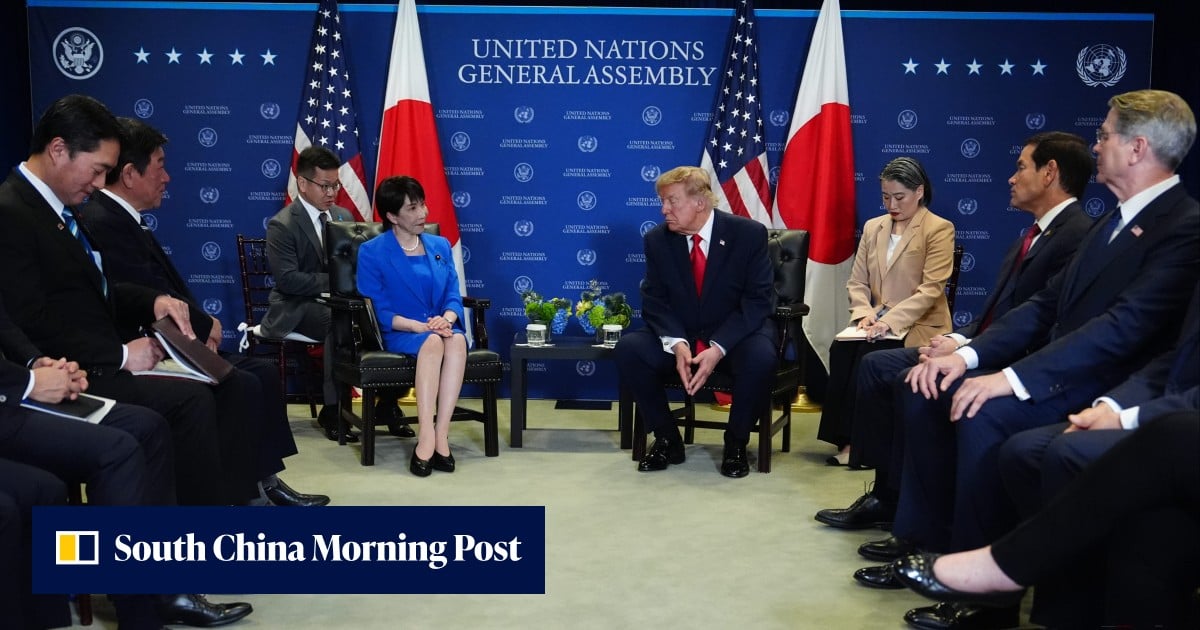
Japan says Trump voiced concern over weak yen in summit with PM Takaichi
US President Donald Trump raised concerns about yen weakness at a summit with Japanese Prime Minister Sanae Takaichi, Japan’s Finance Minister Satsuki Katayama said on Friday, offering an unusually detailed account of the leaders’ talks on currencies. “At the recent Japan-US summit meeting, President Trump expressed concern about the yen’s weakness,” Katayama said at a regular news conference, adding that she was disclosing the exchange for the first time after consulting with the Prime...
Where: Iran, Tokyo, Japan, Washington
Exact coordinates
iran: 32.430, 53.690
tokyo: 35.680, 139.690
japan: 36.200, 138.250
washington: 38.910, -77.040
Read it at South China Morning Post See this on the map
What might happen next? AI-generated
These scenarios are written by an AI language model from the headline and summary above. They are not predictions from the newsroom, and they are not evidence of anything. Every one is given a deadline and checked against later coverage, and the score is published on the ledger — including the ones that miss.
-
Awaiting deadline 35% Immediate Bilateral Alignment
Following the summit, the US and Japan agree on a joint statement to coordinate monetary policy, directly addressing the yen's weakness. This signals a high level of trust and a rapid alignment of economic strategies between the two nations.
Watch for: A joint press release is issued by the US Treasury and the Japanese Ministry of Finance outlining coordinated fiscal measures. · The Japanese central bank holds an emergency meeting where policy adjustments are announced.
-
Awaiting deadline 30% Trump-Led Market Pressure
The US exerts direct, public pressure on Tokyo to reform its monetary policy to stabilize the yen, potentially through statements from senior US officials. This could lead to a temporary, sharp appreciation of the yen as a market reaction to the perceived external pressure.
Watch for: A named US State Department official issues a public tweet referencing currency stability in Japan. · The Tokyo Stock Exchange announces a temporary suspension of trading hours due to volatility.
-
Awaiting deadline 20% Internal Japanese Policy Shift (Counter-Intuitive)
Despite Trump's concerns, the Japanese government decides to prioritize domestic economic growth strategies over immediate currency stabilization, ignoring the US pressure for now. The government frames the focus on internal resilience, leading to continued yen volatility.
Watch for: The Japanese Finance Minister releases a policy briefing explicitly stating that currency intervention is not the priority in the near term. · Japan's exchange rate remains unchanged relative to the USD for 10 consecutive business days.
-
Awaiting deadline 15% Diplomatic De-escalation via Private Channel
The initial public concern is smoothed over through private, high-level backchannels between the leaders. No major policy announcements are made publicly, but the private discussion leads to a quiet understanding that both sides will monitor the situation without immediate action.
Watch for: A joint op-ed is published by a US-Japanese think tank praising the 'successful dialogue' without detailing currency specifics. · A bilateral trade delegation visits Tokyo citing 'economic dialogue' rather than 'currency reform'.
Generated by llama
on 2026-09-25. Checked against later coverage after 2026-10-02.
See how these forecasts score.
ForecastGeo shows the headline and summary published by the newsroom and places the story on a map. The full article lives at the source.