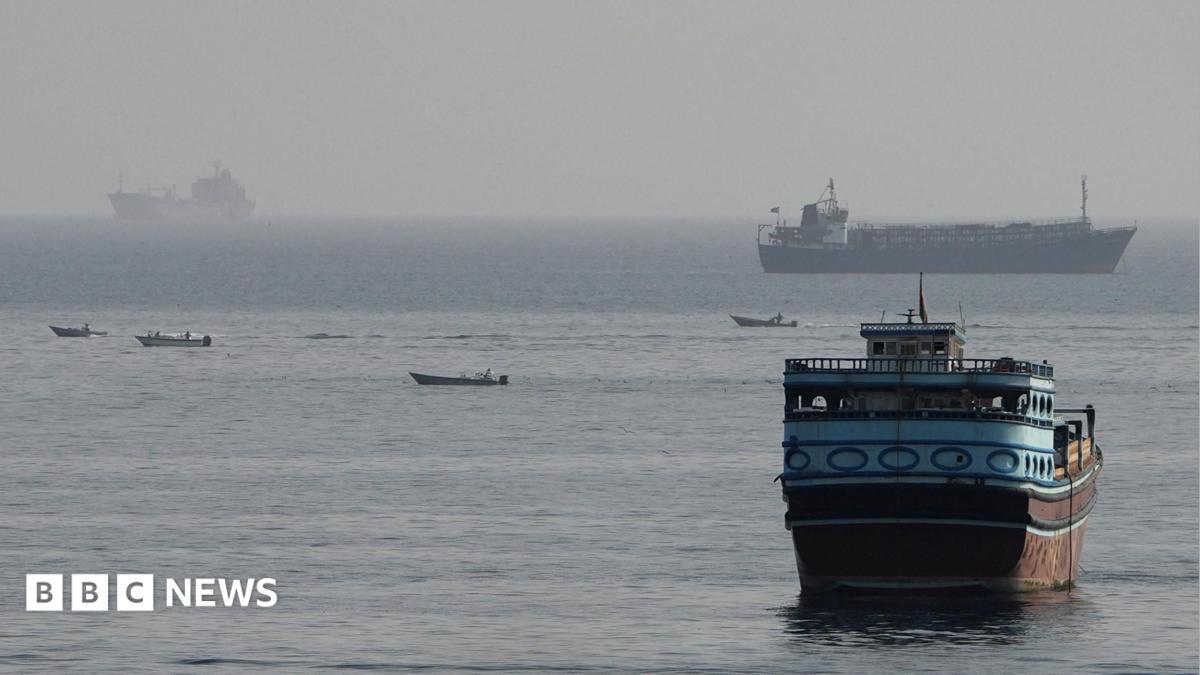
Iran says it has agreed Strait of Hormuz shipping route with Oman
A foreign ministry spokesman did not give details but said an agreement with the Gulf nation was "in the final stages".
Where: Saudi Arabia, Israel, Iran, United States, Washington
Exact coordinates
saudi arabia: 23.890, 45.080
israel: 31.050, 34.850
iran: 32.430, 53.690
united states: 37.090, -95.710
washington: 38.910, -77.040
Read it at BBC News See this on the map
23 outlets covered this story — see how their framing differs
What might happen next? AI-generated
These scenarios are written by an AI language model from the headline and summary above. They are not predictions from the newsroom, and they are not evidence of anything. Every one is given a deadline and checked against later coverage, and the score is published on the ledger — including the ones that miss.
-
Unresolved 45% Measured De-escalation
The agreement acts as a tangible confidence-building measure, leading to a phased normalization of maritime security protocols. Both Tehran and Muscat publicly praise the partnership while quietly integrating new surveillance measures. This reduces immediate friction with international shipping insurance rates.
Watch for: The United States Department of State issues a statement referencing 'enhanced regional cooperation' in Gulf security. · The first joint maritime safety exercise involving Iranian and Omani coast guard vessels is conducted.
-
Unresolved 30% Stalled Negotiations & Return to Status Quo
Despite the final stages announcement, disagreements over the enforcement mechanisms or specific transit fees prevent a formal signing. The agreement remains a diplomatic talking point but yields no operational change. Tensions remain high, as international insurers continue to hike premiums.
Watch for: Iranian Foreign Minister holds a press conference stating that the 'implementation phase is indefinitely postponed'. · A major international shipping firm announces a review of its insurance risk premium specifically citing the lack of clarity on the Hormuz agreement.
-
Unresolved 15% Regional Security Realignment (Counter-Trajectory)
The agreement is not about easing tensions, but about establishing a parallel, semi-autonomous security corridor outside the direct purview of US/NATO enforcement. This subtly challenges existing international maritime norms and establishes a new geopolitical dynamic in the Persian Gulf.
Watch for: The Omani military announces a new bilateral defense pact with Iran, separate from existing Gulf cooperation. · International energy market analysts publish a report predicting a measurable reduction in insurance premiums specifically linked to the 'Hormuz Corridor' designation.
-
Unresolved 10% Sudden Diplomatic Collapse
A critical sticking point—potentially related to specific transit tariffs or the scope of Iranian surveillance—is suddenly discovered, leading to a public breakdown. The agreement collapses without fanfare, and rhetoric hardens immediately.
Watch for: A spokesperson from Muscat issues a brief, highly technical statement detailing 'unforeseen divergences' in the final draft. · An Iranian state-run media outlet broadcasts a sharp editorial criticizing Western interference in regional maritime disputes.
Generated by gemma-4-E4B-it-qat-UD-Q4_K_XL.gguf
on 2026-08-06. Checked against later coverage after 2026-08-20.
See how these forecasts score.
ForecastGeo shows the headline and summary published by the newsroom and places the story on a map. The full article lives at the source.