Iran's president: Time to end war in 'position of strength'
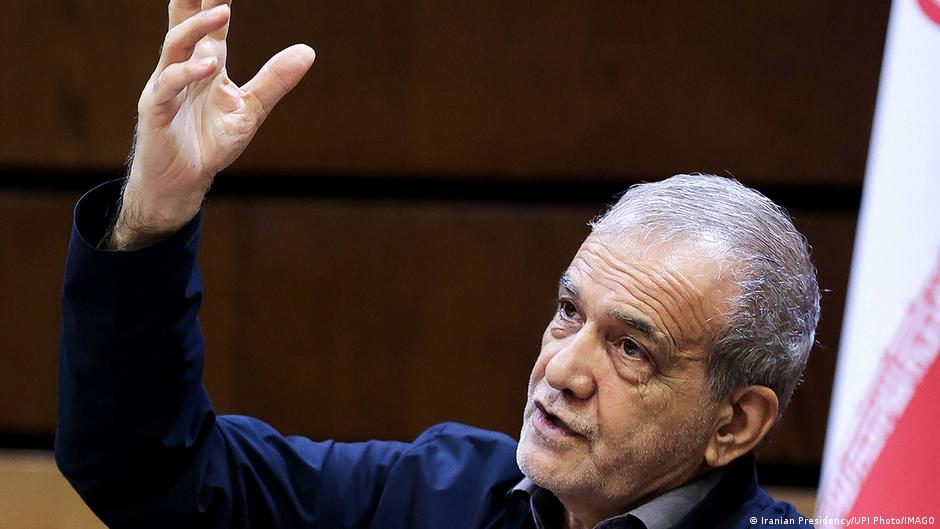
Iranian media cite Masoud Pezeshkian as saying it would be a good time to end the war with the US, "as we are in a position of strength and dignity." He also said Tehran would never "bow to intimidation."
Places named in this report: Washington
Exact coordinates
washington: 38.910, -77.040
Read it at Deutsche Welle See this on the map
What might happen next? AI-generated
These scenarios are written by an AI language model from the headline and summary above. They are not predictions from the newsroom, and they are not evidence of anything. Every one is given a deadline and checked against later coverage, and the score is published on the ledger — including the ones that miss.
-
Unresolved 45% Limited De-escalation Attempt
Tehran uses the rhetoric of 'strength' to initiate a specific, limited diplomatic overture rather than outright aggression. This is seen as a strategic maneuver to gain leverage while maintaining deterrence against the US. The US responds cautiously but accepts a face-to-face channel.
Watch for: The Iranian Foreign Minister announces a scheduled call or meeting with a US State Department official. · US intelligence agencies publish a classified briefing suggesting a willingness to discuss 'limited containment' in the Gulf.
-
Unresolved 30% Sub-threshold Retaliation
Instead of a full military conflict, Iran conducts a high-profile, non-military action to demonstrate its 'strength' and resolve. This act is calibrated to provoke a response from the US but is designed to avoid triggering a full-scale war. This forces a high-stakes diplomatic confrontation.
Watch for: Reports confirm a specific, minor cyberattack targeting a non-critical US infrastructure asset. · A US military spokesperson issues a formal statement confirming the detection of a 'non-kinetic provocation' from Iran.
-
Unresolved 15% Diplomatic Stalemate & Hardening
The rhetoric solidifies into a period of high-tension signaling without any concrete action from either side. Both Washington and Tehran interpret the 'position of strength' as an unwillingness to negotiate on core demands, leading to a temporary hardening of red lines. The international community issues a statement calling for restraint.
Watch for: The US Congress or Senate passes a resolution explicitly stating 'no negotiation' with Iran under current conditions. · A major regional partner (e.g., Saudi Arabia or UAE) issues a statement reaffirming its current security posture against Tehran.
-
Unresolved 10% Surprise Internal Shift & De-escalation
Counter to the assertive tone, internal political pressure or economic strain within Tehran causes a sudden, unexpected policy pivot. A new, pragmatic faction within the political establishment gains traction, leading to an abrupt, unilateral de-escalation of hostilities.
Watch for: Iran publicly announces the suspension of all existing military exercises within 72 hours. · A prominent, non-governmental Iranian economic think tank releases a report detailing the unsustainable cost of the current confrontation.
Generated by gemma-4-E4B-it-qat-UD-Q4_K_XL.gguf
on 2026-08-21. Checked against later coverage after 2026-08-31.
See how these forecasts score.
ForecastGeo shows the headline and summary published by the newsroom and places the story on a map. The full article lives at the source.