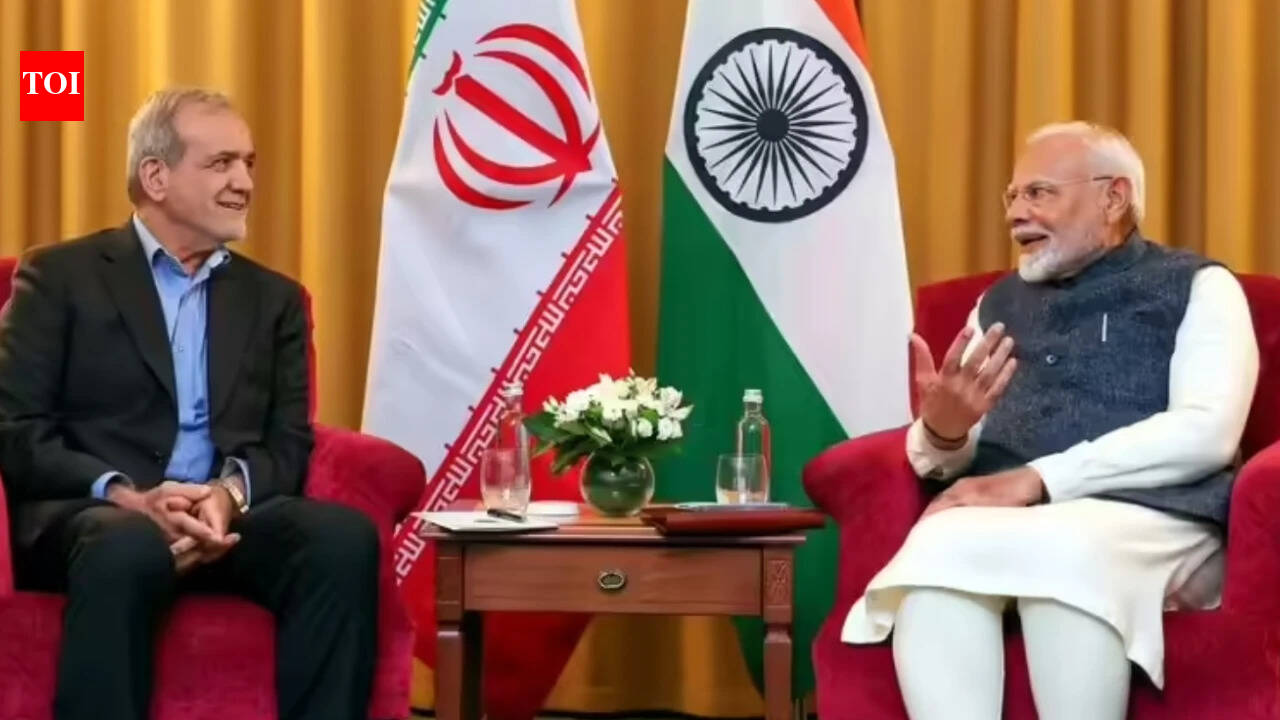
Iran prez to visit India for BRICS summit amid Middle East tensions
Iran has signalled that it sees India as a potential partner in efforts to ease tensions in West Asia, with Iranian Foreign Minister Abbas Araghchi saying New Delhi could play a greater role in de-escalating the ongoing crisis. Araghchi made the remarks during his visit to India in June. He said Tehran did not see a military solution to the conflict and believed that negotiations offered only viable way forward.
Places named in this report: Delhi
Exact coordinates
delhi: 28.700, 77.100
Read it at The Times of India See this on the map
What might happen next? AI-generated
These scenarios are written by an AI language model from the headline and summary above. They are not predictions from the newsroom, and they are not evidence of anything. Every one is given a deadline and checked against later coverage, and the score is published on the ledger — including the ones that miss.
-
Did not happen 50% High-Profile Mediation Offer
During the BRICS summit, India officially proposes a three-party dialogue mechanism involving Iran and key Gulf states to discuss de-escalation. Iran’s Foreign Minister publicly accepts this framework, framing it as a diplomatic victory and signaling Tehran's willingness to engage in multilateral talks rather than military confrontation.
Watch for: Indian Prime Minister announces establishment of a special BRICS working group on West Asia stability · Iranian FM issues a joint statement with Indian counterparts endorsing 'collective diplomatic efforts'
-
Did not happen 30% Rhetorical Alignment with No Action
The summit proceeds with standard diplomatic pleasantries where India emphasizes neutrality and economic ties, but no specific mediation initiative is launched. Iran’s signals are met with vague acknowledgments of 'peaceful resolution' without committing to any active role, maintaining the status quo of low-level engagement.
Watch for: Joint press conference at BRICS summit contains no mention of specific mediation steps or crisis talks · India releases a standard communiqué reaffirming 'principled foreign policy' without referencing de-escalation mechanisms
-
Did not happen 15% Regional Backlash to Mediation
Key regional powers, likely Saudi Arabia or the UAE, publicly reject India’s potential mediation role, citing historical biases or security concerns. This forces India to publicly scale back its diplomatic ambitions during the summit to avoid alienating traditional partners, effectively shelving the de-escalation proposal.
Watch for: Saudi Foreign Ministry issues statement questioning India's neutrality in West Asia conflicts · Indian Ministry of External Affairs clarifies that India will not act as a mediator to avoid regional friction
-
Confirmed 5% Spike in Tensions Overshadows Summit
A sudden military incident or heightened threat occurs in the Middle East just days before or during the summit, forcing India and Iran to pivot from diplomatic engagement to emergency crisis management. The narrative shifts from potential mediation to immediate calls for restraint, rendering the de-escalation talks secondary to urgent security concerns.
Watch for: Report of missile exchange or naval incident in the Strait of Hormuz during the summit week · India recalls ambassador or issues urgent travel advisory for its citizens in the region
Generated by Qwen3.6-35B-A3B-UD-Q5_K_M.gguf
on 2026-08-14. Checked against later coverage after 2026-08-21.
See how these forecasts score.
ForecastGeo shows the headline and summary published by the newsroom and places the story on a map. The full article lives at the source.