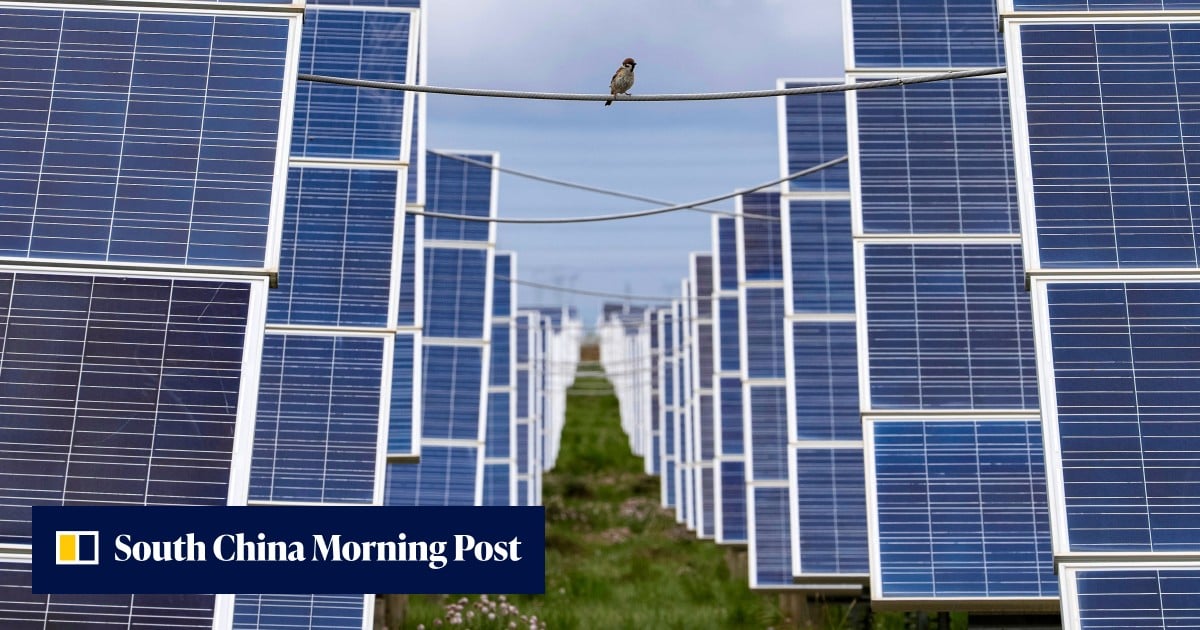
International study finds solar panels in China could be harming birds
Solar expansion policies across China have led to a reduction in bird diversity, with wealthier and non-desert regions bearing the brunt of species loss, according to a study led by researchers in China and the US. They found that solar expansion had eaten into birds’ foraging and breeding grounds, and had left what habitat remained more fragmented, pitting China’s carbon reduction policies against biodiversity conservation. “Our findings highlight a critical green dilemma: without meticulous...
Exact coordinates
vietnam: 14.060, 108.280
china: 35.860, 104.200
Read it at South China Morning Post See this on the map
8 outlets covered this story — see how their framing differs
What might happen next? AI-generated
These scenarios are written by an AI language model from the headline and summary above. They are not predictions from the newsroom, and they are not evidence of anything. Every one is given a deadline and checked against later coverage, and the score is published on the ledger — including the ones that miss.
-
Unresolved 40% Regulatory Pause in Key Provinces
Facing public and international pressure highlighted by the study, key regional governments in the most affected areas issue a temporary moratorium on new solar park installations. This would be framed as an 'environmental review period' rather than a policy reversal. The national government publicly commits to reviewing the study's methodology.
Watch for: The Ministry of Ecology and Environment issues a 30-day moratorium on solar project permits in X number of provinces. · A high-ranking environmental official holds a press conference specifically addressing habitat fragmentation.
-
Unresolved 30% Industry Self-Correction and Mitigation Fund
Instead of stopping expansion, major solar developers form a coalition to fund bird conservation initiatives near existing projects. They announce a standardized, mandatory biodiversity offset fee paid into a national wildlife trust. This allows expansion to continue while addressing the ecological fallout.
Watch for: The China Solar Association announces a 'Green Corridor' funding pledge totaling a specific dollar amount. · The State Council approves a new 'Solar Mitigation Standard' requiring habitat restoration adjacent to projects.
-
Unresolved 15% International Scientific Dialogue Escalation
The study's lead researchers organize a high-profile, televised briefing involving US and EU environmental attaches. This event pressures the Chinese Ministry of Science and Technology to release a public response that acknowledges the ecological findings without altering the national energy targets, leading to a visible diplomatic friction point.
Watch for: A US diplomatic official travels to Beijing specifically to meet with energy ministry counterparts regarding the study's findings. · Official Chinese government release acknowledges 'ecological challenges' while reaffirming carbon targets.
-
Unresolved 15% Accelerated Solar Deployment Despite Findings (Counter-Intuitive)
The national government, prioritizing energy security and climate commitments over localized biodiversity concerns, issues an urgent directive to fast-track deployment in high-potential zones. The directive mandates that existing ecological concerns are subordinate to national energy quotas, effectively sidelining the study's recommendations in the short term.
Watch for: The National Energy Administration releases a new 90-day acceleration order for utility-scale solar projects. · A provincial government overrides local environmental protection agency objections to proceed with a planned solar farm.
Generated by gemma-4-E4B-it-qat-UD-Q4_K_XL.gguf
on 2026-08-21. Checked against later coverage after 2026-08-28.
See how these forecasts score.
ForecastGeo shows the headline and summary published by the newsroom and places the story on a map. The full article lives at the source.