How Saudi Arabia-Turkey-Pakistan defence pact acts as ‘insurance’ over US disengagement
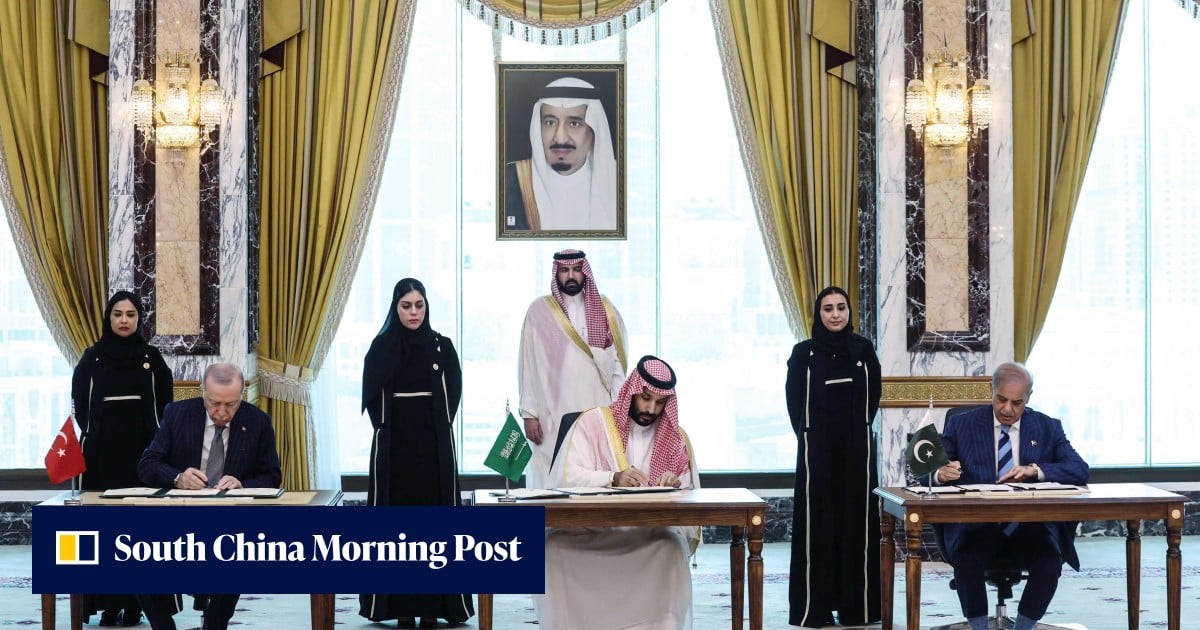
A defence pact among Saudi Arabia, Turkey and Pakistan appears to be aimed at deterring Iran and Israel from tearing up the Middle East with their conflict amid Washington’s inability to guarantee regional security, observers say. Under the terms of the deal signed on Friday in Mecca by Saudi Crown Prince Mohammed bin Salman, Turkish President Recep Tayyip Erdogan and Pakistani Prime Minister Shehbaz Sharif, an armed attack against any one of the three states “shall be regarded as an attack...
Places named in this report: Washington
Exact coordinates
washington: 38.910, -77.040
Read it at South China Morning Post See this on the map
What might happen next? AI-generated
These scenarios are written by an AI language model from the headline and summary above. They are not predictions from the newsroom, and they are not evidence of anything. Every one is given a deadline and checked against later coverage, and the score is published on the ledger — including the ones that miss.
-
Did not happen 40% Regional Arms Race Escalation
The pact serves as a direct challenge, prompting immediate counter-mobilization from regional rivals. Iran and Israel react by increasing their own security posture, viewing the tripartite agreement as a direct encroachment on their strategic spheres. This leads to heightened military readiness across the Gulf and Levant.
Watch for: The US Department of Defense issues a public statement citing 'heightened regional security concerns' in the Middle East. · Turkey announces a new joint military exercise with Saudi Arabia specifically targeting maritime routes near the Red Sea.
-
Confirmed 30% US Re-engagement Signal
The pact's creation is interpreted by Washington not as an alternative, but as an invitation to reassert influence. The US decides to de-escalate its perceived withdrawal by making a high-profile, tangible security commitment to the signatories. This stabilizes the immediate tension.
Watch for: The US Secretary of State holds a joint press conference with Saudi and Turkish officials reaffirming US commitment to regional stability. · The US announces the deployment of a US naval asset to the Arabian Sea within 10 days.
-
Did not happen 20% Internal Political Friction & Stalling
Despite the fanfare, internal disagreements over the precise scope and operational triggers of the defense pact stall concrete action. Key members of the signatories begin negotiating detailed protocols privately, leading to public ambiguity rather than immediate military movement. The pact remains a declaration of intent without immediate operational force.
Watch for: A named diplomat from Pakistan is quoted in an interview expressing 'cautious optimism' regarding the pact's immediate implementation. · No joint military exercises are announced by any of the three nations within the first two weeks.
-
Did not happen 10% Counter-Intuitive Isolation of the Pact
Contrary to its intended deterrent effect, the pact causes the regional powers to view it as a bloc of conservative/anti-Iran interests rather than a neutral security umbrella. Israel and Iran ignore the pact entirely, instead focusing on a bilateral diplomatic channel with a non-member nation to bypass the perceived threat. The pact becomes a symbolic, but operationally irrelevant, gesture.
Watch for: Israel announces a high-level, unscheduled diplomatic envoy meeting with a non-member Arab state. · Turkey issues a public statement criticizing the pact as 'overly defensive' without mentioning any direct military action.
Generated by gemma-4-E4B-it-qat-UD-Q4_K_XL.gguf
on 2026-08-09. Checked against later coverage after 2026-08-19.
See how these forecasts score.
ForecastGeo shows the headline and summary published by the newsroom and places the story on a map. The full article lives at the source.