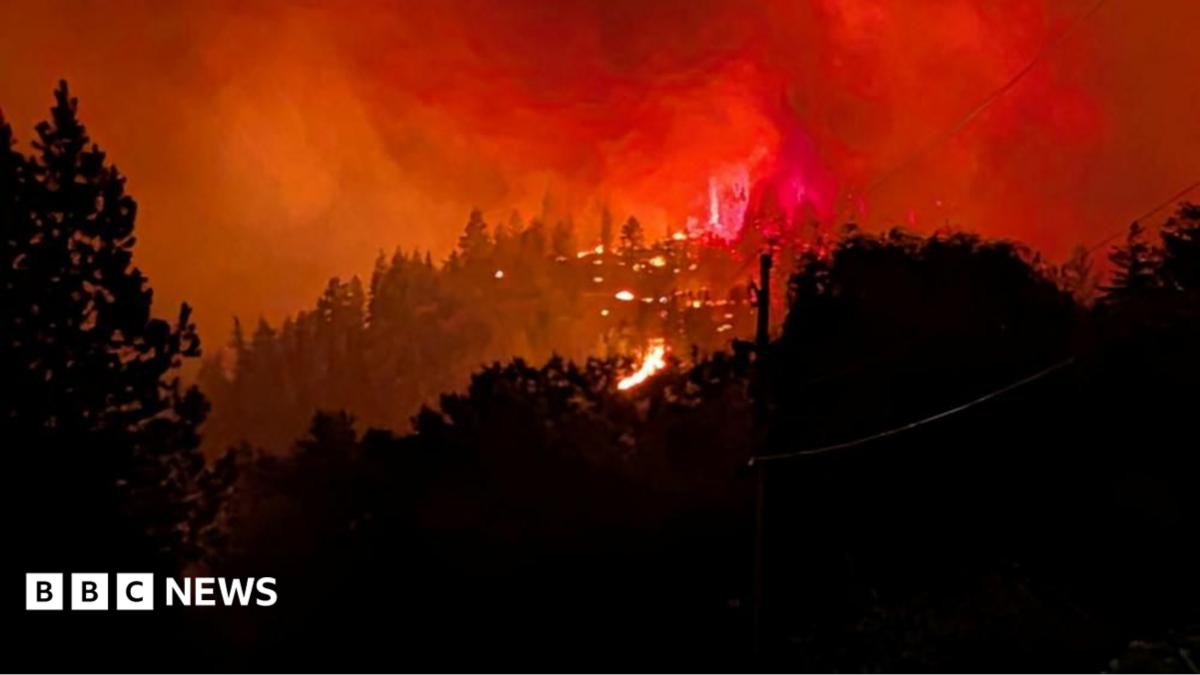
Fast-moving Canada wildfire doubles in size forcing thousands to flee homes
The Bald Range wildfire in British Columbia, still considered "out of control", has spread to more than 36 sq miles (95 sq km).
Where: Washington, New York, Toronto, Canada
Exact coordinates
washington: 38.910, -77.040
new york: 40.710, -74.010
toronto: 43.650, -79.380
canada: 56.130, -106.350
Read it at BBC News See this on the map
2 outlets covered this story — see how their framing differs
What might happen next? AI-generated
These scenarios are written by an AI language model from the headline and summary above. They are not predictions from the newsroom, and they are not evidence of anything. Every one is given a deadline and checked against later coverage, and the score is published on the ledger — including the ones that miss.
-
Unresolved 40% Rapid Containment
Due to favorable wind shifts or a sudden influx of federal resources, fire behavior stabilizes, allowing for systematic containment efforts. Provincial and federal agencies coordinate a unified air support campaign that achieves significant perimeter control. Evacuations begin to wind down in the most affected zones.
Watch for: The BC Wildfire Service announces the establishment of the first permanent containment line around the fire's perimeter. · The provincial government declares a state of emergency lifting the mandatory evacuation order for the nearest community.
-
Unresolved 30% Severe Escalation and External Aid
The fire breaches containment zones rapidly, leading to a critical threat to key infrastructure or communities outside the Bald Range. This forces immediate, large-scale intervention from neighboring jurisdictions or the US for specialized firefighting assets. The provincial government requests emergency declaration of national disaster status.
Watch for: The US Forest Service announces the deployment of a significant number of specialized hotshot crews into the British Columbia interior. · A federal minister holds a press conference announcing immediate, unprecedented financial aid packages for impacted municipalities.
-
Unresolved 20% Localized Crisis and Voluntary Retreat
The fire remains largely uncontained, but the immediate threat shifts from rapid expansion to localized, high-intensity burning pockets. Authorities issue highly targeted, localized evacuation orders for specific hamlets rather than the entire region. Resources are prioritized for protecting critical assets rather than immediate total eradication.
Watch for: Local emergency services issue a specific map detailing only three designated mandatory evacuation zones. · The provincial Ministry of Emergency Management issues a statement prioritizing evacuation over immediate aggressive suppression due to logistical constraints.
-
Unresolved 10% Counter-Intuitive Rapid Burnout/Suppression
Against the established trajectory of expansion, an unexpected confluence of environmental factors—such as a sudden, intense downpour or a rapid drop in fuel moisture—causes the fire's growth rate to sharply decelerate. Fire behavior shifts from a runaway threat to a manageable burn, allowing suppression tactics to regain dominance unexpectedly.
Watch for: Meteorological reports confirm a multi-day 'convective rainfall event' significantly impacting the fire's core temperature. · A regional fire management briefing reports a measurable 20% decrease in the fire's active growth rate over a 48-hour period.
Generated by gemma-4-E4B-it-qat-UD-Q4_K_XL.gguf
on 2026-08-09. Checked against later coverage after 2026-08-16.
See how these forecasts score.
ForecastGeo shows the headline and summary published by the newsroom and places the story on a map. The full article lives at the source.