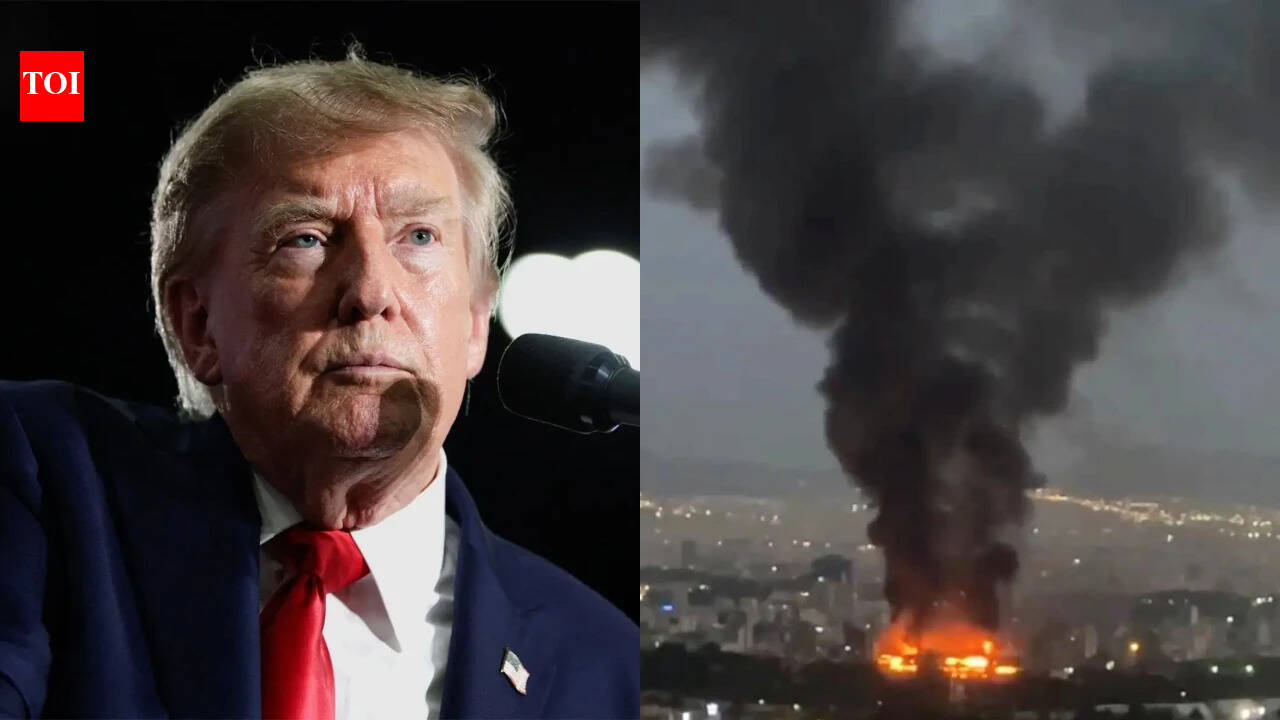
'Do I want to annihilate them?' Trump weighs next phase of Iran war
US President Trump is considering major attacks on Iran. Iran's Revolutionary Guard controls the Strait of Hormuz, restricting vessel passage. The US military maintains a naval blockade on Iranian ports. Recent tanker incidents raise concerns about regional stability and oil flow. Trump will meet Gulf leaders to discuss the conflict's next phase.
Places named in this report: London
Exact coordinates
london: 51.510, -0.130
Read it at The Times of India See this on the map
What might happen next? AI-generated
These scenarios are written by an AI language model from the headline and summary above. They are not predictions from the newsroom, and they are not evidence of anything. Every one is given a deadline and checked against later coverage, and the score is published on the ledger — including the ones that miss.
-
Unresolved 30% Immediate military action
Trump authorizes a limited, high-profile drone or missile strike against a specific Iranian Revolutionary Guard asset near the Strait of Hormuz. This action is designed to signal resolve rather than initiate full war. Following the strike, the US immediately leverages the meeting with Gulf leaders to secure an immediate, binding commitment to a 72-hour de-escalation period.
Watch for: US military releases footage of a specific type of missile/drone impacting an Iranian target · Iranian state media broadcasts a formal protest from a named high-ranking official
-
Unresolved 35% Diplomatic de-escalation
The meeting with Gulf leaders successfully unites the regional bloc in a unified front against Iranian aggression. Instead of military confrontation, the US uses this platform to broker a highly publicized, temporary agreement to ease tanker traffic in exchange for specific Iranian concessions regarding port access. This avoids immediate war but sets a stage for future negotiations.
Watch for: A joint statement from Gulf Cooperation Council (GCC) nations formally endorses a US-led mediation plan · The Strait of Hormuz traffic volume shows a measurable, statistically significant increase in daily vessel traffic
-
Unresolved 20% Status quo maintenance
Despite the high rhetoric, the Trump administration decides the risk of immediate conflict outweighs the benefit of an immediate strike. The meeting with Gulf leaders results in a cautious alignment of interests but no concrete military commitment from either side. The US naval blockade remains in place, but the pressure to escalate subsides slightly as the immediate oil flow crisis temporarily stabilizes.
Watch for: US Navy issues a public advisory stating 'no change in current operational posture' regarding the blockade · Iran announces a specific, non-aggressive domestic policy change, unrelated to the Strait of Hormuz
-
Unresolved 15% Unlikely internal pivot (Counter-Trajectory)
Unexpected domestic political pressure or a sudden internal change in US policy leads Trump to abruptly pivot away from military action altogether. He cancels the planned Gulf leaders' meeting, citing a need to focus on domestic economic issues. Simultaneously, the US military announces a targeted 'diplomatic engagement' mission in Iran, instead of a military one, signaling a shift in focus.
Watch for: The scheduled meeting with Gulf leaders is formally postponed with an official presidential tweet or press release · A US embassy in Iran announces the appointment of a new, high-level 'Senior Envoy for Dialogue' position
Generated by llama
on 2026-09-18. Checked against later coverage after 2026-09-21.
See how these forecasts score.
ForecastGeo shows the headline and summary published by the newsroom and places the story on a map. The full article lives at the source.