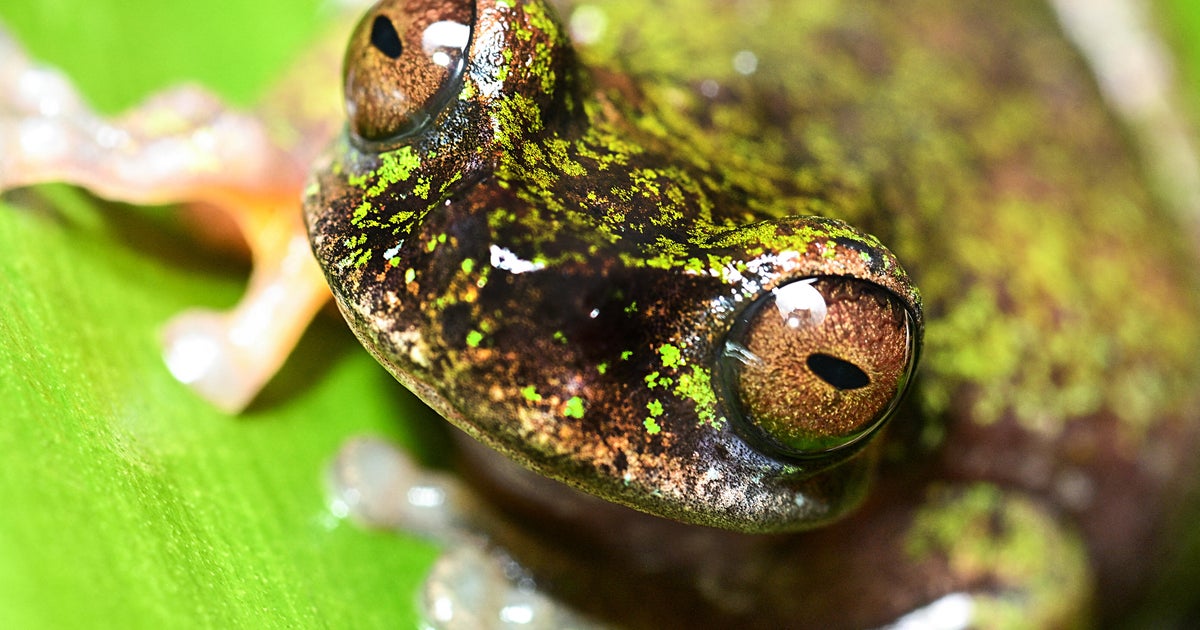
Costa Rica's newly discovered "coffee frog" faces risks from farm pesticides
Measuring less than 4 centimeters and known as the "spring frog," the dark green-spotted amphibians were observed in San Lorenzo de Tarrazu.
Places named in this report: Argentina
Exact coordinates
argentina: -38.420, -63.620
Read it at CBS News See this on the map
What might happen next? AI-generated
These scenarios are written by an AI language model from the headline and summary above. They are not predictions from the newsroom, and they are not evidence of anything. Every one is given a deadline and checked against later coverage, and the score is published on the ledger — including the ones that miss.
-
Unresolved 40% Regulatory Intervention
Local environmental NGOs and the Costa Rican Ministry of Environment (MINAE) successfully pressure the regional farming cooperatives to immediately implement pesticide reduction zones around known habitats. This forces a rapid, localized shift in agricultural practices.
Watch for: MINAE issues an emergency decree restricting neonicotinoid use in Tarrazu for the next 30 days. · A public joint statement is released by the local farming association and the Ministry endorsing reduced pesticide use.
-
Unresolved 30% Commercial Impact
Due to the negative PR surrounding the amphibian discovery, major international coffee exporters in the region face consumer boycotts. This leads to immediate, voluntary adoption of sustainable farming techniques by large producers to protect market access.
Watch for: A major international coffee buyer (e.g., Starbucks or Nespresso) issues a press release citing 'sustainable sourcing' requirements for San Lorenzo de Tarrazu. · Local coffee cooperative leadership announces a shift to organic certification within the week.
-
Unresolved 20% Scientific Validation & Study
The discovery triggers a rapid influx of academic interest. Researchers are granted immediate access to the sites, leading to intensive, non-intrusive study of the frog's lifecycle and toxicology to establish precise risk levels.
Watch for: A university researcher announces the commencement of a field study in San Lorenzo de Tarrazu. · A published preliminary report from the Ministry of Science and Technology details initial findings on pesticide exposure levels.
-
Unresolved 10% Industry Defiance (Counter-Intuitive)
Faced with minimal immediate governmental oversight, the local agricultural lobby successfully argues that the frog is too small to pose an ecological threat and that current pesticide use is necessary for regional economic survival. They successfully lobby against any immediate regulatory changes.
Watch for: The Costa Rican Agricultural Chamber formally petitions the legislature to delay any environmental restrictions for the next fiscal year. · Local news reports the successful defense of current pesticide applications in Tarrazu against environmental concerns.
Generated by gemma-4-E4B-it-qat-UD-Q4_K_XL.gguf
on 2026-08-09. Checked against later coverage after 2026-08-23.
See how these forecasts score.
ForecastGeo shows the headline and summary published by the newsroom and places the story on a map. The full article lives at the source.