Chinese buyers acquire US soybeans for October-November, traders say
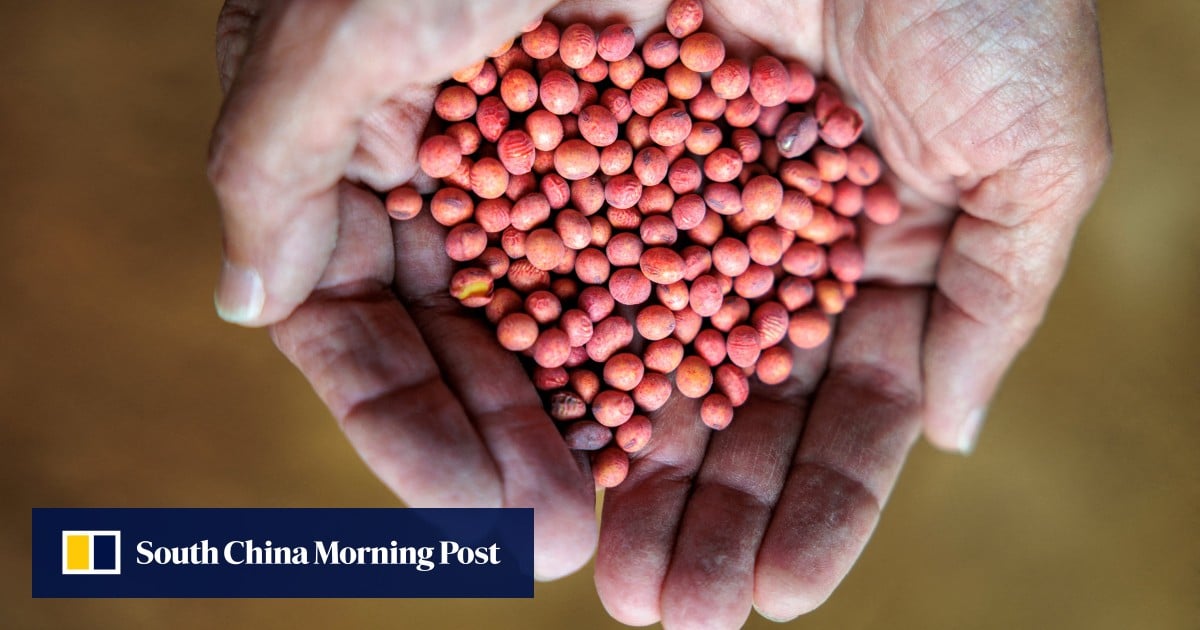
Chinese government buyers bought at least eight cargoes of US soybeans on Friday for shipment from US Gulf Coast terminals and six cargoes for shipment from Pacific Northwest ports in October and November, two US traders with knowledge of the deals said. The sales volume of at least 840,000 tonnes was among China’s largest single-day purchases this month after the world’s top soybean importer restarted purchases from the US in late June. China had slowed purchases of American soybeans over...
Places named in this report: Brazil, China, United States
Exact coordinates
brazil: -14.240, -51.930
china: 35.860, 104.200
united states: 37.090, -95.710
Read it at South China Morning Post See this on the map
What might happen next? AI-generated
These scenarios are written by an AI language model from the headline and summary above. They are not predictions from the newsroom, and they are not evidence of anything. Every one is given a deadline and checked against later coverage, and the score is published on the ledger — including the ones that miss.
-
Unresolved 55% Gradual Trade Normalization
The soybean purchases signal a de-escalation in agricultural trade tensions as Beijing seeks to stabilize domestic food prices. Washington and Beijing engage in low-profile technical negotiations, leading to a steady, month-over-month increase in US agricultural exports without high-profile political announcements. This path reflects a pragmatic approach where economic necessity overrides ideological friction.
Watch for: US Department of Agriculture reports a 20% month-over-month increase in soybean exports to China in October · Chinese Ministry of Commerce issues a statement praising the 'constructive tone' of recent trade discussions
-
Unresolved 30% Continued Volatile Stagnation
Despite the recent large purchase, Chinese buyers remain cautious, shifting volumes unpredictably between US, Brazilian, and Argentine suppliers based on daily price arbitrage and political signaling. The initial surge in purchases fizzles out as Beijing avoids over-reliance on American agriculture, maintaining a status quo of intermittent, small-scale deals rather than sustained commitment. This keeps US farmers in a state of uncertainty without triggering a broader trade war.
Watch for: Chinese port data shows a sharp 40% drop in US soybean unloading volumes in December compared to November · US Soybean Export Council releases quarterly report citing 'inconsistent demand patterns' as a key risk factor
-
Unresolved 10% Diversification Away from US
The recent purchases are revealed to be a temporary cover for accelerated efforts to secure long-term contracts with Brazil and South America, reducing dependence on US geopolitical risk. Beijing announces new infrastructure investments in South American rail and port systems, effectively locking in supply chains that bypass the US entirely. US exporters face a structural decline in market share as Chinese buyers prioritize supply security over short-term pricing advantages.
Watch for: China signs a 10-year bilateral agreement with Brazil guaranteeing the purchase of 50 million tonnes of soybeans annually · New Chinese-owned rail terminal opens in Mato Grosso, Brazil, with capacity to handle 20 million tonnes per year
-
Unresolved 5% Sudden Trade Retaliation
The soybean purchases trigger a backlash from US political opponents who view them as exploitation of US farmers, leading to new non-tariff barriers or sanitary inspections against other Chinese goods. In retaliation, Beijing abruptly cancels all remaining October contracts and imposes sudden tariffs on US corn or pork, escalating the situation into a broader agricultural trade conflict. The brief thaw in relations collapses rapidly as political pressures mount in both capitals.
Watch for: China Customs Administration announces immediate suspension of inspections for all US agricultural shipments · US President announces new tariffs on Chinese electric vehicles and batteries in response to the soybean deal
Generated by Qwen3.6-35B-A3B-UD-Q5_K_M.gguf
on 2026-07-31. Checked against later coverage after 2026-08-14.
See how these forecasts score.
ForecastGeo shows the headline and summary published by the newsroom and places the story on a map. The full article lives at the source.