Abraham Accords countries hold first official meeting since Oct. 7 attacks
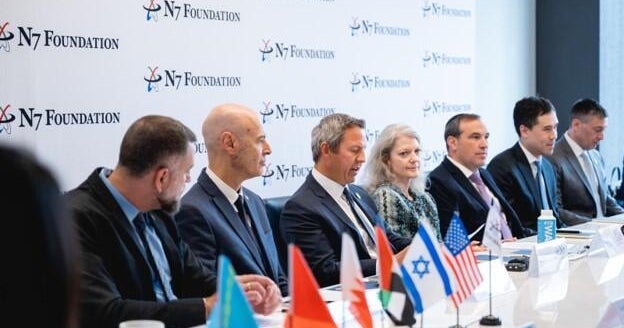
Ten blocks away from the United Nations General Assembly, U.S. diplomats quietly kickstarted the expansion of the Abraham Accords from the 43rd floor of a midtown Manhattan office tower.
Where: United Arab Emirates, Saudi Arabia, Florida, Israel, Iran, United States
Exact coordinates
united arab emirates: 23.420, 53.850
saudi arabia: 23.890, 45.080
florida: 27.660, -81.520
israel: 31.050, 34.850
iran: 32.430, 53.690
united states: 37.090, -95.710
Read it at CBS News See this on the map
What might happen next? AI-generated
These scenarios are written by an AI language model from the headline and summary above. They are not predictions from the newsroom, and they are not evidence of anything. Every one is given a deadline and checked against later coverage, and the score is published on the ledger — including the ones that miss.
-
Awaiting deadline 35% Immediate Diplomatic Momentum
The high-level meeting successfully generates immediate momentum, leading to a public statement of renewed commitment from key regional leaders. This signals a concerted effort to insulate the Accords from the current regional instability.
Watch for: A joint press release from representatives of the Abraham Accords member states is issued. · One of the involved US diplomats holds a press conference specifically mentioning 'renewed commitment' to the Accords.
-
Awaiting deadline 25% Internal Stalemate and Quiet Delay
Despite the initial meeting, significant internal disagreements persist among the participating nations regarding the scope of the Accords' expansion. The initiative stalls in bureaucratic processes without a major public announcement.
Watch for: No public joint statement is released within 10 days of the meeting. · The US State Department issues a procedural update regarding the Accords' next steps, indicating a pause for internal consultation.
-
Awaiting deadline 15% Counter-Intuitive Regional De-escalation
Running counter to the current climate, the regional partners use the momentum from the meeting to facilitate a low-profile, non-security-related trilateral meeting between two key partners (e.g., Morocco and Israel) to address economic cooperation.
Watch for: A meeting between two Abraham Accords nations is confirmed by a third-party news agency, focusing solely on trade or infrastructure. · The focus of U.S. diplomatic coverage shifts away from security/conflict toward economic partnership metrics.
-
Awaiting deadline 25% Immediate External Pressure/Rejection
The timing of the meeting is perceived by regional adversaries as a sign of weakness or strategic miscalculation. This leads to an immediate, visible, and sharp diplomatic or military response from a regional actor.
Watch for: A named regional political leader issues a sharp public statement criticizing the Accords meeting's timing and contents. · A small-scale, non-military border incident is reported between a regional power and one Accords nation within 3 days.
Generated by llama
on 2026-09-25. Checked against later coverage after 2026-10-02.
See how these forecasts score.
ForecastGeo shows the headline and summary published by the newsroom and places the story on a map. The full article lives at the source.